

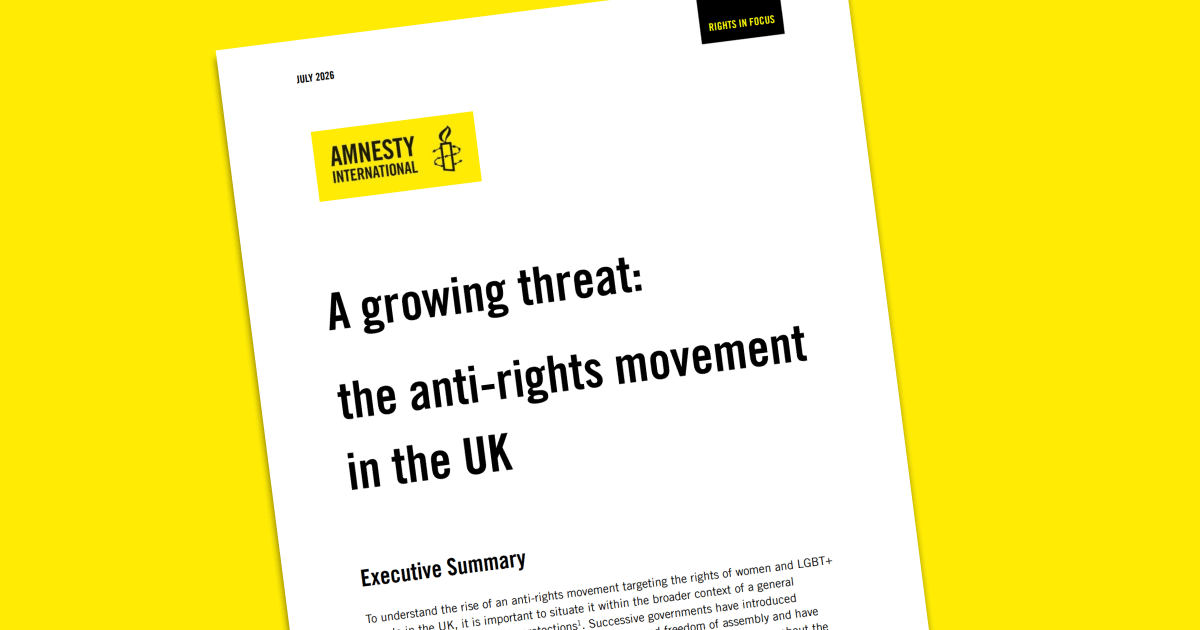
For about forty-eight hours earlier this month, you could read on Amnesty International UK’s website a report: A growing threat: the anti-rights movement in the UK.
Then it was gone.1
Published on the 8th, withdrawn on the 10th, replaced by the language of the corporate near-apology: the briefing had gone up “without going through the established internal review processes,” its “use of language does not reflect” the organisation’s position, an internal review is underway.
Take that sentence apart, and it says something precise. Not we were wrong. Not this was untrue. Only: this escaped the building before we had dressed it properly. A process failure. A textual wardrobe malfunction.
I want to make a small and blunt claim in the other direction. The report met Amnesty’s criteria exactly. It reflects the organisation’s position with unusual clarity — which is precisely why it had to be taken down. And there is one thing in it, the most revealing thing, that The Times and the rest of the media coverage sailed straight past.
I’ll come to that. It’s the reason I’m writing this article.
There is an old line, well worn by repetition because it keeps turning out to be true: believe people when they show you who they really are. Not who they say they are when the lawyers’ letters arrive. Who they are when they think the room is friendly and the document is internal, and no one important is looking. Amnesty showed us. The withdrawal is not a retraction of who they are. It is embarrassment at having been seen in their naked, most natural state.
One: making women who protect women dangerous

You can read elsewhere — The Times covered it, so did the broadsheets, so did the lawyers — why the wider world recoiled. So I’ll be brief and again direct about it.
Amnesty took a hundred and seventeen organisations and poured them into a single vat labelled anti-rights. One table. One combined figure. One moral colour. Into that vat, alongside the genuinely troubling, went the women’s groups: FiLiA, Woman’s Place UK, Sex Matters, LGB Alliance, For Women Scotland. And Beira’s Place — the free, confidential service in Edinburgh for women who have survived rape and sexual violence, founded and funded by J.K. Rowling after the Edinburgh Rape Crisis Centre came to be run by a trans-identifying man.
A charity that exists so that a woman who has been raped can, if she needs to, be heard by another woman — that charity is entered into a national ledger of threats to human rights. Not for anything it did. For what it is. Its offence is the provision of care on the basis of sex.
The report never has to call these women dangerous. The structure of their report does it for them. It puts a rape-crisis centre in the same column as clinic harassers, and the column makes the accusation you were too careful to write. Amnesty’s own numbers give the game away: the gender-critical groups it spent fifty-one entries denouncing account for two and a half per cent of the spending it mapped. £3.6 million, across fifty-one groups, over six years.
This was never a following-the-money exercise. The money was never the point. The listing was the point — the placing of women who protect women onto a register of the accused.
Two: they only came for the Christians
Then there is something else in the report, commented on by many but not as widely. Read the list of the religious.
Every single one is Christian.
The Christian Institute, CARE, the Evangelical Alliance, the Catholic Bishops’ Conference, Christian Concern, the Christian Legal Centre, Anglican Mainstream, the Catholic Herald. One hundred and seventeen organisations, and not one Muslim body. Not one Hindu, not one Sikh, not one Orthodox Jewish institution — though every one of those traditions holds, often more firmly than the average Anglican, exactly the convictions Amnesty is prosecuting: that sex is real, that the family has a given shape, that a woman is a woman.
Do not let anyone tell you this is a failure of balance, a regrettable oversight, a diversity problem in the research team. It is not clumsiness. It is deliberate ideological targeting and aim.
Amnesty knows these other communities exist. Amnesty knows what they teach. It chose. And the choice tells us two things at once about Amnesty. It tells us which faith it feels safe to name — the majority one, the culturally Christian one, the one that will write a strongly worded response and perhaps a Substack, but will not make the organisation's life difficult. And then some Christians will take the report and flagellate themselves with it, castigate themselves masochistically, because there is nothing certain kinds of Christians like better than believing how terrible they are. And some will go one step further, siding with Amnesty in a desperate bid to prove themselves a different kind of Christian from the ones named on the list. And the choice by Amnesty tells us which faiths they will not touch, because touching them costs something in their coalitions it cannot afford to fracture.
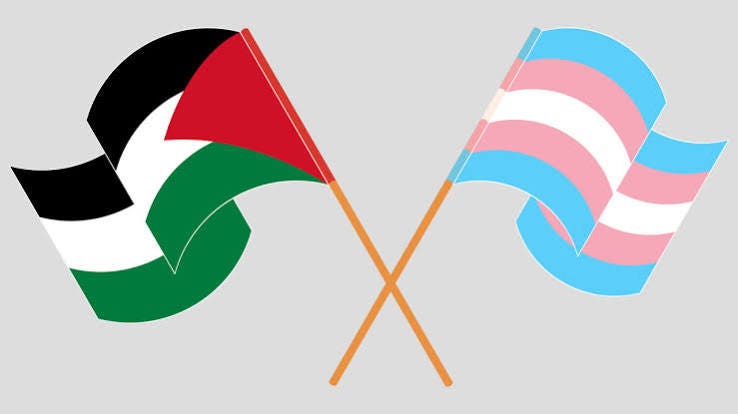
That coalition has a texture. The activist wing of trans politics and the activist wing of pro-Palestinian politics are fused at the level of theory — bound by an intersectional creed in which every liberation is the same liberation and every oppression the same oppression. So a banner can read, untroubled by their cognitive dissonance, trans liberation cannot happen without Palestinian liberation.
You may find the pairing incoherent. But coherence is not the currency here. Alliance is. And an organisation living inside that alliance will scour the Christian West for its villains and fall silent — carefully, deliberately silent — before every other tradition on earth that believes the same forbidden things.
A principle that is only ever applied to the group you were already willing to lose is not a matter of principle. It is a target.
Three: the anthropology under the report

Now the thing that the media missed, and the thing worth reading in the article.
Strip the funding tables away, and this report rests on a doctrine of the human person. It has an anthropology — a theology of what a self is — and it is stated with a confidence its authors probably didn’t even notice they were showing.
Here is the doctrine. That the self is authored, not given and received. What you feel yourself to be, you are; and your sense of yourself outranks every other testimony — your body’s, your history’s, your maker’s. The report says this without arguing it. It treats the claim that gender is constructed and fluid as established fact — “progress,” it writes, “has been underpinned by changing understandings of gender and social roles” — and it treats the older claim, that sex is a given feature of a given nature, as mere belief, penned inside scare quotes: what these people “view” as “natural,” as “traditional.”
One account, the view of human identity by Amnesty, is given the dignity of being called ‘true’, treated as knowledge, whilst that of anyone who disagrees is pathologised.
And then the Amnesty report overplays its hand so badly that it makes its ideological and pseudo-religious confession. It lists the tell-tale signs of a dangerous movement — the markers of “anti-rights” activity to be watched, defunded, and where possible legislated against. Among them are: Appeals to nature. Appeals to family. Appeals to tradition, to religion, to the good of the community, to the safety of children.
Read that list in the report slowly. It is not a list of harmful acts. It is a list of the sources from which a human being might receive an identity rather than invent one. Nature, family, faith, heritage, belonging — the furniture of a life that comes to you before you choose it — reclassified as the machinery of oppression.
This is the point of the report most people seemed to miss, and it is the point that matters most. We are not watching a policy disagreement by Amnesty. We are watching two ontologies meet, and one of them announces that the other is a human rights violation for having ever existed and currently existing. Behind almost every ferocious argument in public life now — this one, and all the ones next to it — sits this same fault line: not what should we do, but what is real, and where does a legitimate self come from.
The report is one side of that line, dressed as neutral fact-finding. It holds that the human person is unmoored — free not only to act but to define, cut loose from body, lineage, culture, and creed — and that to say otherwise, to insist that some of what we are is given and good and not ours to revoke, is not a different view but a malicious offence against the person.
There is a deep irony sitting within this.
An identity that must be self-created can never be secure. It rests on no given, so it has to be propped up again and again — by affirmation, by agreement, by the removal of every voice whose mere existence suggests disagreement is possible. That is why the report cannot simply state its view and let it compete in the open. It ends, instead, with a request to the Charity Commission: strip the charitable status of organisations that believe the human being is given rather than made. Investigate them. Defund them. Clear them from the public square.
Read that as what it really is. A worldview so unstable it experiences the mere existence of disagreement as harm, and therefore cannot leave the disagreement standing. This is not a competing ontology content to argue its corner. It is one that requires the other to be gone. Not answered — but removed and disappeared.
Believe them
For a long time the Christian position in this country has been the modest one, and I still think it is the right one: sex is real and good; the person is given before they are chosen; and adults are free to believe what they wish and live as they choose — right up to the point where it harms someone else. Believe whatever you like about yourself. Only do not compel me to say I believe it too, and do not build your peace on the silencing of my beliefs. That is not cruelty. It is the ordinary grammar of living together while disagreeing in a healthy democracy.
But we have often held that position lazily — assumed the givenness of things was so obvious it needed no defence, so secure it could be left untended, so widely shared it would always be there when we reached for it. It is not obvious any more. It is not shared. And an institution like Amnesty that used to defend the persecuted has now published — with, whatever it says, its full authority — a map of the people it would like the state to persecute, and put women who shelter the raped on it.
The report was pulled. It was not isolated, and it grew from the Amnesty report, like a snowball, published in May, which is still online at the Amnesty site as I write. That is the real tell here. Amnesty did not change its mind this July. It changed the draft that got out and is biding its time before releasing its next one.
Believe them. They have shown you who they are.
They will be back, but better dressed. And be ready knowing who they really are.
You can download an archived version of the report here: https://tinyurl.com/4edbhumu
I am aghast, disheartened, disturbed and angry. What can we do? What must we do?