

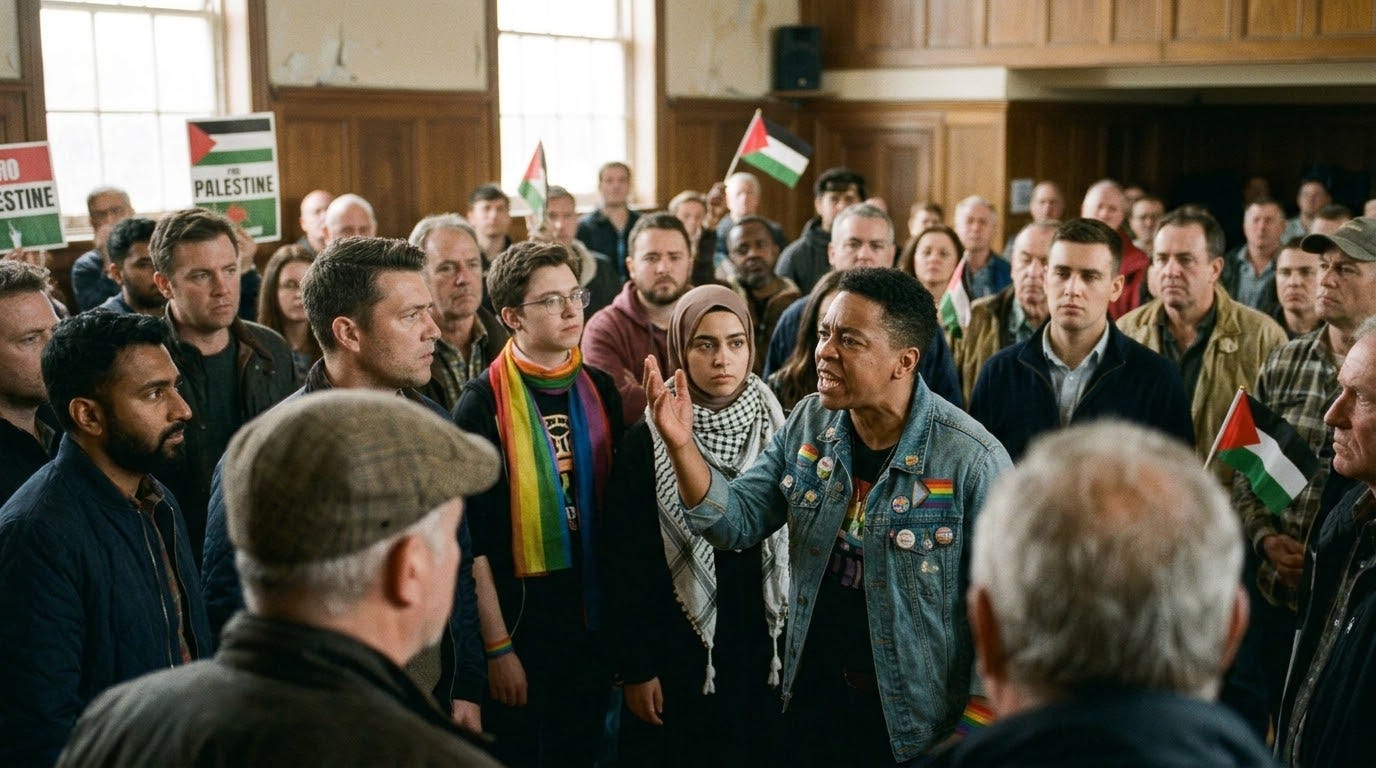
Most of us have noticed it, sometimes in the family group chat. We have replaced critical thinking with moral certainty.
I see it in friends I have known for years—people who are kind, intelligent, and prayerful, yet who now rally to causes with a fervour I have not seen in my lifetime. Abortion. Climate change. Israel and Gaza. Reparations. The care of children who identify as transgender. And now, with war spoken of as a real possibility rather than a distant memory, pacifism. On each of these issues, people hold absolute certainty—in completely opposite directions. Worse, they find it harder and harder to imagine how any decent person could think otherwise.
The Deep Currents: How we got here
I have spent much of this year writing about the currents that run beneath all this. We have lost a shared story, the account of who we are and where we are going that once allowed neighbours to disagree while still living in the same world. Decades of relativism and postmodern suspicion have taught us to hear every claim to truth as a bid for power. And into that vacuum have rushed ideologies that behave like a grammar, shaping what we are able to say before we have had the chance to think it, along with single ideas cut into master keys that promise to open every door.
All of that remains true. Yet I have begun to wonder whether there is also a simpler explanation—one that lies closer to hand and offers a kinder way of understanding one another.
We are tired.
Overwhelmed: Why a finite mind reaches for certainty
I am paid, in part, to think. As a trained, paid academic, my work is to read about hard questions, weigh them, and help others do the same, and I have to confess that I am losing track. How many of the issues facing us can I possibly read about, let alone research and understand? I am trained for this.
And I am exhausted by it.
Before breakfast, a connected world delivers every global crisis to the phone in my hand. Each arrives with its experts and counter-experts, asking me to care, to decide, to take a stand—and ideally to have posted about it by lunchtime. The volume alone would be overwhelming. Beneath it, though, lies something harder still: we no longer disagree only about what to do.
We disagree about what is real.
The psychologist and theologian Richard Beck offers a picture that has helped me see this more clearly. Our convictions, he suggests, rest in three layers. On the surface lies the moral layer—our sense of right and wrong and the public debates we wage over it. Beneath that is the existential layer—the stories and symbols that give our lives meaning. And at the foundation lies the ontological layer (from the Greek word for being): simply what we take to be real. Each layer grows out of the one beneath it, much as a plant grows out of its soil.
Consider the care of children who identify as transgender. On the surface, the argument is moral: is this treatment right? Underneath it, though, two very different stories are being told. In one, a child is being set free to become who they really are; in the other, a child is being harmed before they are old enough to consent. And underneath those stories lie two competing accounts of reality: one in which the truest thing about us is an inner sense of self, and another in which it is the body we have been given. We can argue on the top layer for as long as we like, but we will not settle a disagreement that lives at the bottom.
Now multiply that by every issue on our screens. Each brings the strain Leon Festinger called cognitive dissonance: the discomfort of holding ideas that refuse to fit together. Each brings an emotional dissonance as well, and beneath both, an existential one—for what is ultimately at stake is who we are and whether our lives make sense. Yet we meet all of this without the tools we need. Few of us were ever taught to think critically, and even those who were no longer share the vocabulary, grammar, and story required to think together. The less we share, the harder thinking becomes—and the harder it becomes, the less of it we do on own let alone with others.
No one can stay open to all of this at once. Something must resolve the strain, and the nearest thing at hand is moral certainty. I have come to think that moral certainty is often a defence mechanism—and perhaps a necessary one—for minds that simply cannot do the critical thinking this moment demands.
Borrowed Certainty: Feeling sure about what we have not thought through
The psychologist Daniel Kahneman had a name for this shortcut: substitution. Faced with a hard question, our minds answer an easier one instead, and never notice the swap that has taken place. The hard question might be what is true about this war, this treatment, or this policy? The easier one is how I feel about it, and how the people I trust feel about it. The feeling arrives all at once, at full strength, and with certainty, and we mistake its strength for knowledge and truth.
I have started calling the result borrowed certainty: convictions on loan from our friends, our feeds, and our tribes, never paid for in reading or in thought.
I need to be careful here. I am not saying that certainty is wrong; some things deserve it, and moral passion has ended real evils. Nor is borrowing itself the fault. I have never checked the evidence for most of what I believe about medicine, history, or physics, and I doubt you have either. Trust is simply how human beings come to know things, and anyone who waits until they have read everything will never act at all. The trouble begins when we forget that we borrowed and start spending the loan as though we had earned it.
So I have begun to put a few questions to my own certainties, and war, which presses on us again, makes a good test case. One Christian is certain that Jesus forbids all violence, and that anyone who says otherwise has left the gospel behind. Another is just as certain that defending the innocent by force is plain common sense, and that pacifists are naive.
Can I explain my view, rather than merely defend it? In one study, researchers asked people to describe, step by step, how the policies they supported would actually work. Having tried, participants discovered they understood far less than they had supposed, and their views then grew less certain and less extreme. The pacifist, for instance, could try explaining what actually happens to an invaded neighbour; the defender of force could try naming the conditions the Church sets before any war can be called just.
Where did I get this certainty, and what did it cost me? Did I earn it through slow reading and hard questions? Have I genuinely tested it against those who see things differently? Or did it simply come packaged with the crowd I joined—or the one I left? When we have only ever met one view, it does not feel like a view at all. It feels like the gospel.
If my honest answers turn out to be “no,” “no,” and “from my friends,” then I am borrowing. That does not make me wrong, and it is not necessarily a bad thing. But I do need to be honest that I have bypassed a great deal, that I am leaning on somebody else’s judgement, and that I ought at least to know whose.
Everyone Stands Somewhere: Shortcut or foundation
None of this means we can manage without a place to stand. Nobody thinks from nowhere; even the sceptic who doubts everything is trusting his doubt. We cannot think through everything, and so we have to choose something to underpin everything else. The only real question is whether we choose it on purpose and how we choose.
Jesus ended the Sermon on the Mount with a story of two builders. Both houses met the same weather: “The rain came down, the streams rose, and the winds blew and beat against that house” (Matthew 7:25). It is not a bad picture of what comes at us every day. The weather was the same for both. What differed was the foundation.
And that suggests a distinction I keep coming back to. A shortcut is where thinking stops; a foundation is where thinking starts. One lets us borrow an answer so we never have to wrestle with questions; the other gives us solid ground from which to wrestle well.
Jesus himself can be made into either, and Christians have long been tempted to turn his name into a shortcut. Today he is enlisted for the flag by some and for social justice by others, with equal confidence and equal urgency, and usually to end an argument rather than begin one. That is Jesus as one more borrowed certainty: a human verdict claiming his authority.
What I am suggesting is a change of starting point. Rather than using Christ to settle the issues quickly, we make him our deeper concern, the one we have thought about longest and loved most, so that he becomes our way into the issues rather than our way round them.
Which leaves me with one more question for myself. Does my Jesus ever disagree with me? If he never does, I have not followed him. I have recruited him.
The Logos: A place to stand, and what it asks of leaders

Why build there? John’s Gospel opens with the reason.
In the beginning was the Word, and the Word was with God, and the Word was God. He was with God in the beginning. Through him all things were made; without him nothing was made that has been made. (John 1:1–3)
The Greek for “Word” is Logos, which also carries the sense of reason: the order and meaning running through all things. This is the Christian claim about the very soil of what is real. At the bottom of things is a person, and all things were made through him. If that is so, reality can be understood, and no truth, wherever it turns up, can threaten him. Faith does not excuse me from thinking; it sets me free to think. That is what the Church has long called faith seeking understanding.
And you cannot use a person the way you use a position. When a man in the crowd asked Jesus to settle a family dispute over an inheritance, he answered, “Man, who appointed me a judge or an arbiter between you?” (Luke 12:14). A position can be picked up and swung like a weapon; a person has to be followed. Paul adds that “in him all things hold together” (Colossians 1:17). There is real relief in that, because it means I do not have to hold the world together myself.
I cannot prove any of this from the outside, and I am not claiming that Christians think better than anyone else. Our history rules that out far too often. Jesus, after all, was crucified by morally certain people who had decided it was better for one man to die for the nation than for the whole nation to perish (John 11:50). Which is why I need lenders as well as a foundation. I borrow upon a foundation.
A tribe is the people who agree with me now. A tradition is something older and stranger. It includes the dead, and people quite unlike me, and it has been arguing with itself for two thousand years. G. K. Chesterton called tradition “the democracy of the dead,” a way of giving our ancestors a vote. The Nicene Creed is the plainest example I know. The Church did centuries of hard thinking so that none of us would have to work out the Trinity alone, and the Creed opens with the words “We believe.” That is borrowed certainty that knows it is borrowed—the honest kind.
A fair critic will say that a tradition is just a tribe with a longer memory, and that this one has been badly wrong. And that is, alas, all too often true. Christians once defended slavery from the Bible. Yet other Christians, reading the same Bible, brought slavery down. That is the real difference: a tradition carries within itself the means of its own correction. Nor does it hand me ready-made verdicts. On war, it offers me two positions, the long careful argument between them, and wiser voices than my own to join in the conversation.
So let me lay my cards on the table. I stand in historic, creedal Christianity: the faith of the creeds, the sacraments, and the Church’s long teaching, catholic with a small c. That is the centre around which I move. When I have to take a shortcut, as I must, I borrow from there, because these are people who have kept Christ at the heart of what is real. That is also why I cannot make my home in a faith that treats church and creed as optional, leaving each of us to compose a Christianity of our own. Nor can I live in a rigid fundamentalism where the answers are already sealed, and the questions themselves are forbidden. I have friends in both; I love them, and I learn from them. But I need lenders to borrow from who can tell me where I am right and why, and who are also able to tell me that I am wrong. Everyone has their lenders. These are mine.
What, then, does this ask of leaders? Leaders who will not think, learn or take advice have always been dangerous, and they are especially dangerous now. Yet no leader can think about everything either. Suppose someone stops you at the church door after the service to ask where you stand on Gaza, or assisted dying, or whatever the week has thrown up. The temptation is to produce a certainty on the spot, because leaders are supposed to have them. And people often want to borrow from you.
There is another way to answer, and it is both harder and better. It goes something like this: Here is what I have examined, and what I concluded; here is what I am taking on trust, and from whom; and here is what I do not know. A leader who speaks like that gives the people around them permission to do the same, including permission to say, “I do not know enough to hold a view on that.”
None of this excuses laziness. It is simply a practical way to deal with the overwhelm, instead of trying to have a take on everything. Test this habit on a single issue.
First, check your foundation. Give your best study and prayer to Christ before you read the arguments, so you are thinking from him rather than reacting to the latest outrage. Second, choose one question and sit with it. Try explaining, step by step, how your position actually works. Mark out what you have studied for yourself and what you have taken on trust, and name the voices you are leaning on. Are they rooted in a tradition that can tell you where you are right and why, and also tell you when you are wrong? Third, set the other issues aside for now, without pretending to have answers you have not done the work for.
I think again of my friends, so sure and so divided. I don't want them to care less, and I don't want to care less myself. What I would love is for us to be able to tell one another which of our certainties we have earned and which we have borrowed, and from whom. So, who are your lenders? And could they tell you that you are wrong?
May you find the freedom to say “I do not know” about so many things, and the deeper certainty of trusting the one who holds all things together, whatever you face.