

The most virtuous-sounding language in public life is often doing something other than what it appears to do. Learning to see this is one of the most important and urgent tasks facing Christian leaders.
A few weeks ago, I wrote a piece called How People Cheat in Arguments. It was a map of the language games. The straw men, the deflections, the tone policing, the moving goalposts and the small sleights of hand by which a conversation about an idea suddenly becomes a conversation about you and your virtue, or lack of.
A way of speaking that, when it occurs, ordinarily thoughtful people seem to lose the ability to think.
Let me show you what I mean.
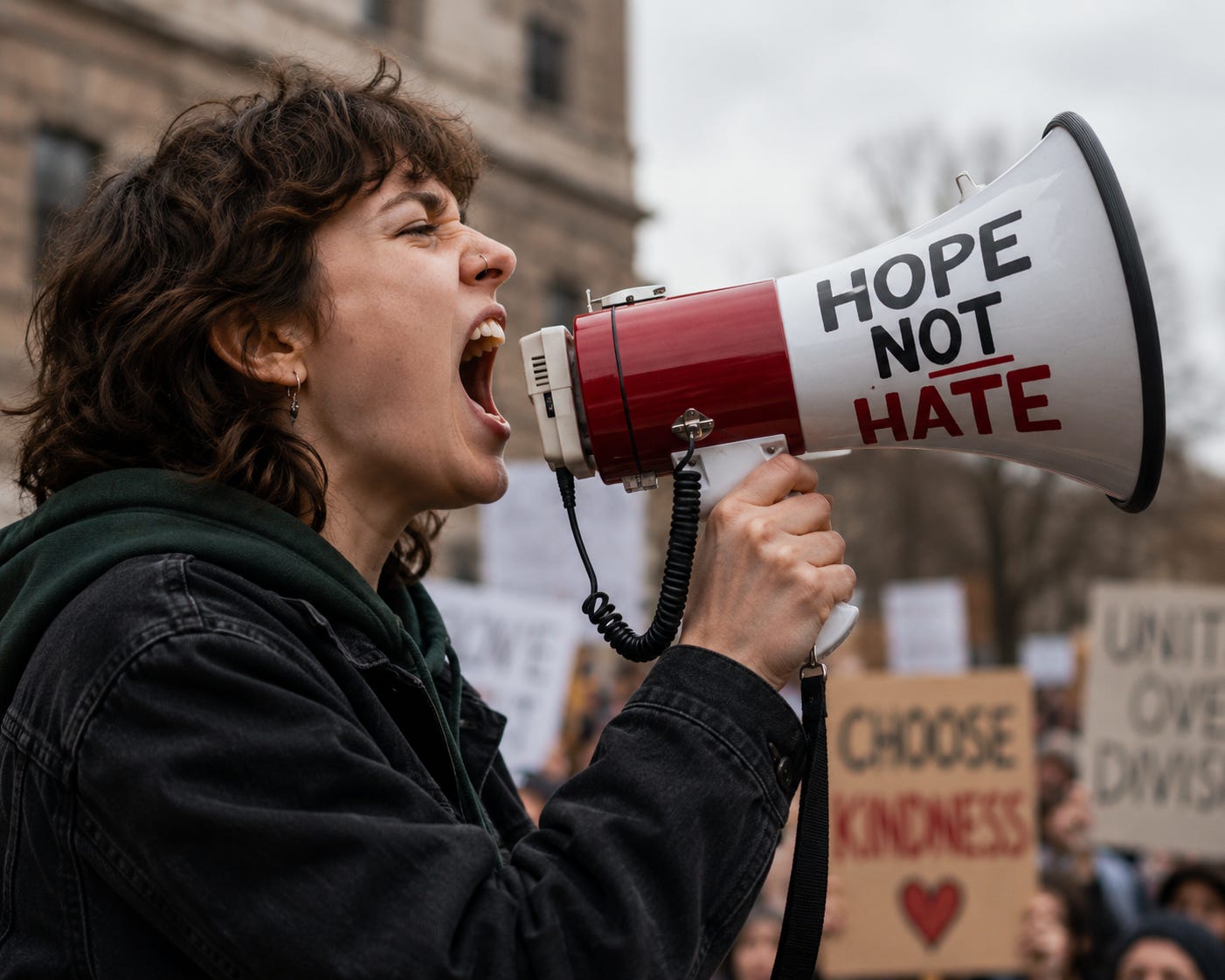
Consider three of the most morally attractive words you could ever put on a banner.
Hope. Not. Hate.
Now who, exactly, is going to argue with that? Who wishes to stand up and declare himself for hate and against hope? The phrase appears to mark a distinction so obvious that only a wicked person could object to it.
Yet those who use such phrases often seem most consumed by hate.
How is that?
The groups who march most loudly under the banner of hope are often the very ones who appear most consumed by contempt for the people they oppose. The language of love sits strangely alongside the conduct of calls for violence.
You feel it. Yet you likely cannot name it. And because you cannot name it, you cannot answer it.
That is the position a great many leaders find themselves in. They sense that a trick is being played. They simply do not have the words to describe the trick, the categories with which to diagnose it, or the tools with which to refuse it.
So let me try to offer all three.
The Classification Sleight of Hand

The first thing to see is that a slogan like Hope Not Hate is not making a claim. It is performing a classification.
Before anyone has said a word about immigration, policing, community cohesion, or national identity, the identity politic roles have already been handed out. One side stands in the place of hope. The other is now deemed to stand in the place of hate. Any argument has effectively been settled before it has begun.
And once you start looking, you see the same move everywhere.
A discussion about immigration becomes a discussion about compassion. A discussion about crime becomes a discussion about prejudice. A discussion about schools becomes a discussion about inclusion. A discussion about biological sex becomes a discussion about dignity and safety.
In each case, the actual subject disappears and is replaced by a moral abstraction. And once that substitution has taken place, disagreement becomes almost impossible. You are no longer arguing about a policy. You are apparently arguing against compassion, inclusion, dignity, and hope itself.
This is the genius of it. The disagreement has not been won. It has been relocated — from the level of ideas and beliefs, where it could be examined, to the level of identity, where it cannot.
Sacred Words Become Weapons
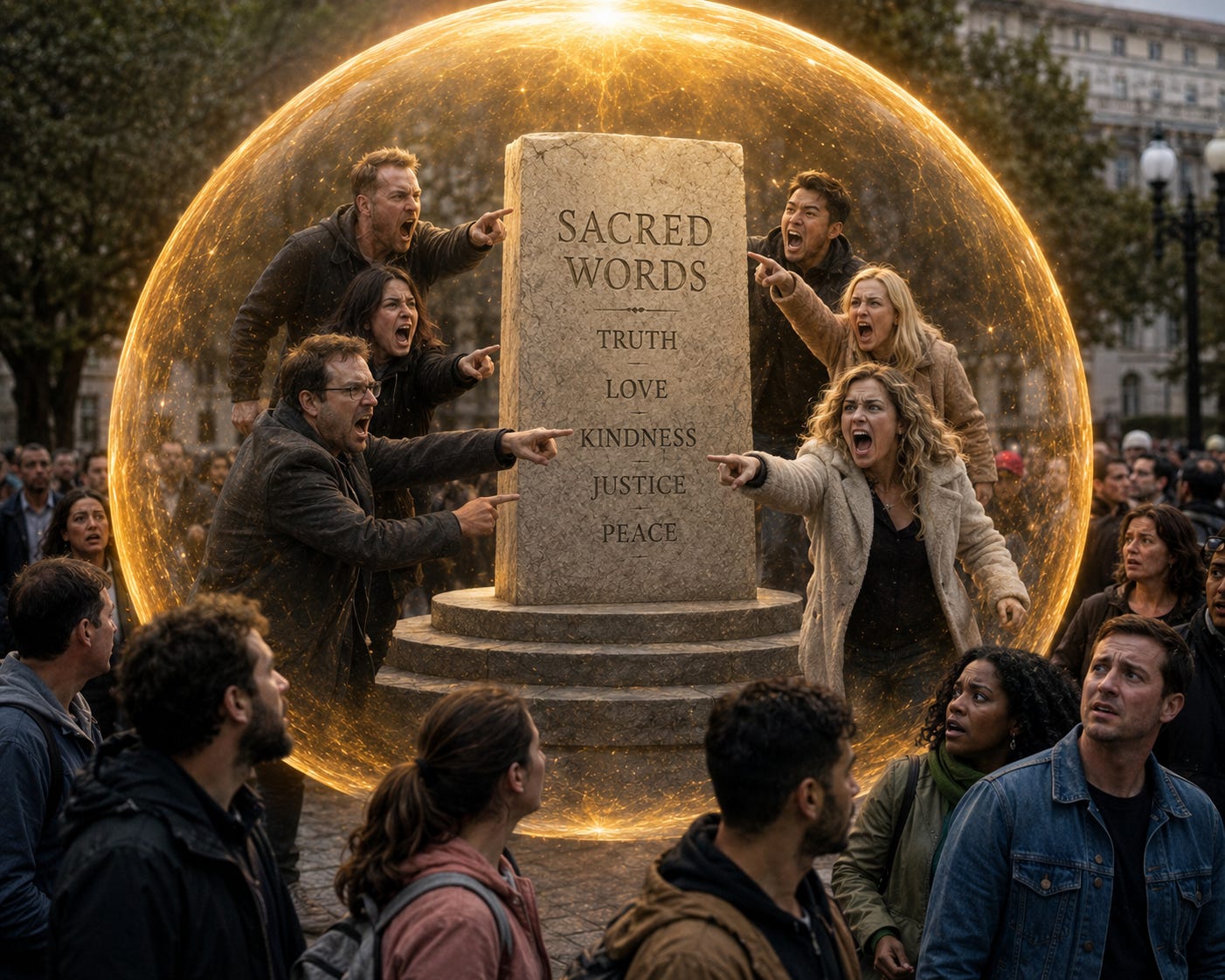
Richard Beck has written helpfully about what he calls social nouns: abstract moral words that modern societies treat almost as sacred objects. Justice. Diversity. Inclusion. Equity. Freedom. Hope. They carry an enormous emotional charge. And they are almost never ever defined.
That is not an accident. Their power lies precisely in their vagueness.
Almost nobody opposes justice. Almost nobody opposes inclusion. Almost nobody opposes hope. The disagreement only begins when someone asks what those words actually mean in this case, for these people, with these consequences. But that is the conversation the slogan is designed to prevent.
Instead, one group succeeds in quietly attaching its own interpretation to the word — and from that moment, to disagree with the interpretation is to disagree with the virtue. The abstraction acquires a kind of moral immunity. Question it, and you have not raised an objection. You have revealed a defect in your soul.
This is why evidence so often stops working. No quantity of data competes well with a sacred word. The argument is no longer happening at the level of facts. It is happening at the level of belonging and virtue signalling.
Virtues Are Not Possessions
What is happening is not a matter of rhetoric but of reality itself.
Historically, the Christian tradition treated virtues such as hope, justice, truth, and love as transcendent realities grounded in God. They were not possessions. No person, no party, no nation, no church could claim to own them. We stood beneath them and were measured by them.
And Christianity was deeply suspicious of anyone who claimed otherwise — because Christianity has always understood how prone human beings are to self-deception. We confuse our interests with righteousness, our tribe with truth, our preferences with the will of God. So we are accountable to the good. We do not get to be its proprietor.
Identity politics reverses this completely.
The movement no longer stands beneath the virtue. The movement becomes the virtue. Hope is no longer a standard we all answer to; hope becomes the property of a particular coalition. Justice is identified with a programme. Inclusion is identified with an ideology.
And once that happens, the consequences are entirely predictable.
If the movement is justice, then to criticise the movement is to be unjust.
If the movement is inclusion, then to criticise it is to be exclusionary.
If the movement is hope, then to criticise it is to be hateful.
A political disagreement is transformed into a moral contamination. And that is why these arguments feel so strangely violent. One person thinks they are debating a policy and a belief. The other experiences it as an assault on the sacred — and, by extension, on themselves.
It also explains the contradiction we began with. A movement that talks endlessly about tolerance can become astonishingly intolerant, because dissent is no longer a difference of opinion.
It is heresy.
The hatred is not a betrayal of the headline banner. The banner is working exactly as its users intended.
And this is not a sin of the left. Nationalist movements do it. Religious movements do it. Any tribe can seize a transcendent good and turn it into a private weapon. The issue was never left versus right. The issue is what happens whenever human beings try to capture something that belongs to God and convert it into a possession of their own.
The Christian Temptation

Which is exactly where we have to turn the lamp on ourselves.
Because Christians are not spectators to this trick. We are often its most fluent practitioners now and in the past.
Consider what a virtue actually is.
In the Christian tradition, a virtue is not a badge you wear. It is the far end of a road. Patience is what a person slowly becomes. Courage is the settled shape of someone formed by grace over time. The virtue names the destination of a process and that process is grounded in something real: a person being remade, by the Spirit, into the likeness of Christ.
The virtue has a telos. It is going somewhere, and it is rooted in someone.
Now remove the road, but keep the badge and slogan. Strip out the long, humbling formation and keep only the marker of having arrived. What you are left with looks like virtue but is something else entirely: the performance of holiness, detached from the process that produces it and the reality that grounds it.
That is purity culture.
A community policing the signs of righteousness while disconnected from the One in whom righteousness is found. A moral vision floating free of its ontological anchor in Christ. And it mutates and ferments into exactly the same thing we have been describing in secular politics: the tribe captures holiness, purity, truth, and makes them its property, and turns them into instruments for sorting the clean from the unclean.
We did the linguistic magic trick first. We simply used churchier words.
So if we are going to name this in the public square, honesty requires us to confess it in the sanctuary.
How To Refuse The Game

None of this means hope is bad, or justice is bad, or inclusion is bad. Quite the opposite. It means they are far too important to be handed over to any tribe — including ours.
So how do we respond? Not by becoming louder. By becoming clearer.
Refuse the role you have been assigned. The slogan only works if you accept the classification. You do not have to. You can calmly decline to be sorted: I have not told you I am against hope, and you have not yet told me what you mean by it.
Separate the word from the interpretation. This is the single most useful response available to a leader. I am not against hope. I am questioning your account of what hope requires of us here. That sentence reopens the conversation the slogan was trying to close.
Ask the diagnostic question. Whenever you meet a phrase that sounds self-evidently virtuous, ask quietly: What argument is this slogan stopping us from having? That question almost always reveals more than the slogan ever could.
Put the good back under God. Refuse, on principle, to let any movement own a virtue. Stand beneath the standard rather than behind it. The most disarming thing a Christian can say is that the very virtue being weaponised will one day judge the person wielding it — and judge us too.
Restore the telos. And in our own house, stop asking are we pure? and start asking, are we being formed toward Christ? The first question produces inquisitors. The second produces saints.
And now the part that matters most of all.
None of this is guaranteed to work. Not because the tools I’ve mentioned are weak, but because the person in front of you may no longer be able to hear them or bear to hear them. When someone has fused their identity with a virtue, a question about it does not land as a question. It lands as an assault on their very being. You are not poking at an argument. As far as their nervous system is concerned, you are attacking who they are in totality
So be ready for the reaction.
You can stay calm, stay precise, refuse the role, separate the word from its interpretation — do everything right — and a person fully captured may still respond with something closer to panic than rational thought. They will declare that they feel unsafe. They will say the conversation itself is harmful. They will announce that they cannot do this and walk away. Or they might just shout an existential scream at you.
Do not mistake that for your failure. It is the diagnosis confirming things.
The dissonance is real, and for them it is genuinely unbearable. To question the virtue is to risk the self that has been built upon it, and their mind would sooner flee than hold two incompatible things at once. The existential alarm, the language of harm, the sudden exit — these are not rebuttals of your points. They are a measure of how much was resting on the slogan in the first place.
Your task is not to persist more forcefully; it is to differentiate. It is to remain the calmest, kindest, least anxious person in the room and to leave the door open.
And you can stand there — present, unthreatened, unmoved — for one reason. You are not holding the virtue up. It is holding you.
Virtue, or the Signal of It
Here, then, is the distinction underneath all of the above.
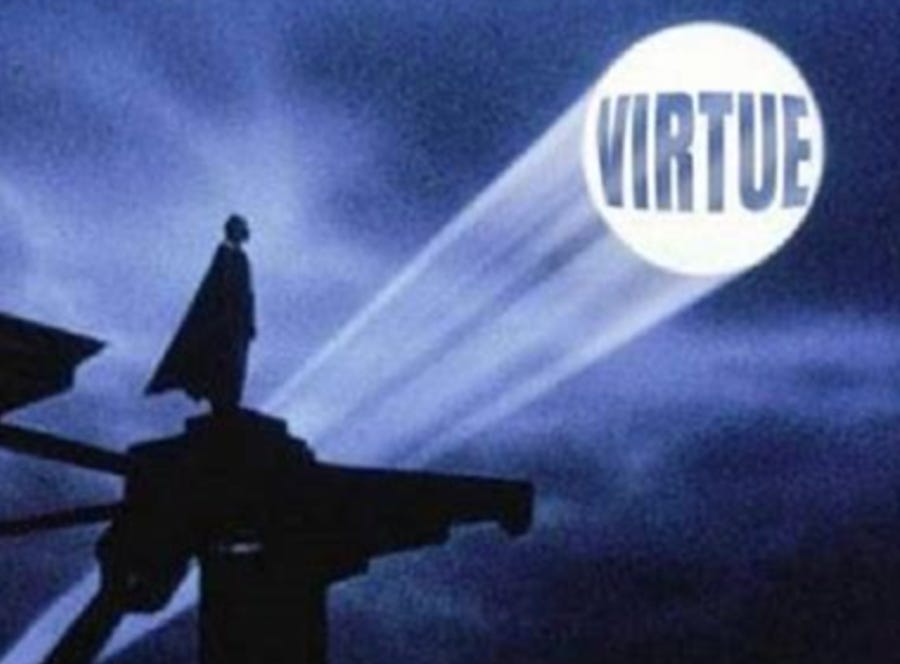
Virtue signalling is the claim to own a virtue. Virtue is the willingness to be judged by it.
The signaller stands above the standard and uses it to sort other people. The saint stands beneath the standard and is slowly remade by it. One holds the word as a weapon. The other is held by it as a master.
So there is a simple test for which one you are looking at — in others, and in yourself. Ask whether the virtue is allowed to convict the person invoking it. A hope that can only ever indict your enemies is not hope. It is a flag in the colour of hope, flown over a fortress of virtue signalling.
Real hope, like real justice and real love, belongs to no party. It belongs to God. Every movement stands beneath it. None of us gets to own it.
And the deepest form of power was never the power to make and force people to agree with you. It is the power to persuade them that disagreement itself is proof of moral failure.
That is the achievement of identity politics. It turns argument into contamination, and conversation into a loyalty test.
Our task, as leaders, is not to win that game.
It is to refuse to play it and to keep insisting, gently, relentlessly, and hopefully that the things worth fighting over are precisely the things none of us is allowed to own.
I love this statement. “The groups who march most loudly under the banner of hope are often the very ones who appear most consumed by contempt for the people they oppose.” It speaks to the lack of integrity we see on display throughout society. Or maybe it calls each of us to humbly evaluate and pursue our own integrity.
That makes sense and is very helpful. I've never before been able to put my finger on what's happening here. thank you