

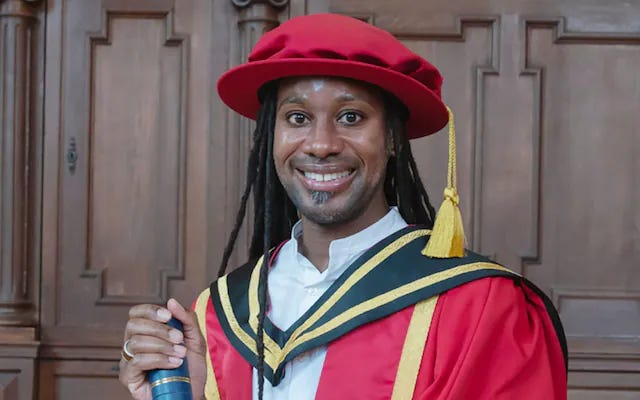
A university appoints a professor whose life story seems almost impossibly inspiring.
He has overcome profound childhood difficulties, learned to speak and read unusually late, become a successful academic, raised millions of pounds for charity, completed extraordinary endurance challenges and broken one of Britain’s most significant racial barriers. His appointment is celebrated across the media. For the university, he becomes more than a professor. He becomes the embodiment of progress.
Then the questions begin.
Large parts of his doctoral thesis appear strikingly similar to an earlier thesis. Academic positions listed in his biography reportedly cannot be confirmed by the institutions concerned. Accounts of charitable fundraising and endurance running begin to require substantial clarification. Then an old recording appears in which he seems to claim that, as a child, he featured in a famous television programme first broadcast more than twenty years before he was born.
At this point, we might expect everyone to stop and examine the evidence.
Instead, many begin by examining the people presenting it.
What are their motives? What politics do they hold? Are they racist? Are they hostile to disability? What damaging cause might be strengthened if any part of the accusation were conceded?
Some of those questions may be entirely legitimate. But they are not the first question.
The first question is whether the claims are true.
Why is that simple question sometimes so difficult to ask? Why, when the evidence against something grows, do intelligent people sometimes become more committed to defending it? Why does contradiction lead not to reconsideration but to greater certainty? Why do institutions preserve stories that are becoming increasingly expensive to maintain? Why do all of us find it easier to investigate the character of a critic than the truth of what the critic has exposed?
The answer lies in one of the most powerful and misunderstood forces shaping our everyday lives: cognitive dissonance.
We usually think of cognitive dissonance as the discomfort we experience when two of our beliefs contradict each other. But more recent developments in the theory suggest something deeper and, I think, far more revealing.
We often resolve contradictions in ways to appease the psychological discomfort around our beliefs. And sadly, we often do not approach contradictions to discover what is true. But neuroscience has discovered something more about our primary mode of dealing with cognitive dissonance.
Often, we resolve it so that we can keep going.
The Mind’s Need To Keep Moving

The idea of cognitive dissonance is usually associated with the psychologist Leon Festinger.1 His basic insight was that human beings find inconsistency psychologically uncomfortable.
I believe that I am wise, but I have made a foolish decision.
I believe that I am compassionate, but I have behaved cruelly.
believe that an institution is trustworthy, but evidence suggests that it has concealed wrongdoing.
I believe that a leader is anointed by God, but credible allegations of abuse have emerged.
Something has to give. We might change our behaviour, revise our belief, minimise the evidence, reinterpret what happened or blame the person who brought the inconsistency to our attention.
That familiar account remains important, but it can make cognitive dissonance sound like little more than the mind’s attempt to relieve an unpleasant feeling. Like a psychological irritation that needs to be soothed.
The more recent action-based model, developed especially by the psychologist Eddie Harmon-Jones and his colleagues, asks why cognitive inconsistency troubles us so much in the first place.2 Their answer is that many of our beliefs and perceptions carry implications for action. When those implications point in different directions, decisive action becomes difficult. Cognitive dissonance signals that something is obstructing our ability to move. Reducing the dissonance allows us to recover a coherent direction and act with renewed confidence.
Imagine that I have publicly defended a leader, institution or cause. I have encouraged other people to trust it. I may have donated money, built relationships around it or staked my reputation upon it.
Then evidence appears that I may have been wrong.
The contradiction is no longer between two abstract ideas. It is between two possible courses of action.
I can continue defending what I chose, or I can stop, admit that I may have been mistaken and accept the consequences.
The greater my investment, the more costly the second option becomes.
My mind therefore begins to work. I minimise the evidence. I attack its source. I reinterpret the accusation. I appeal to the importance of the larger cause. I insist that examining the claim will empower bad people. I broaden the argument until the original fact disappears inside an enormous moral controversy.
My mind is not necessarily asking, “What best explains the evidence?”
It may be asking, “What must I believe in order to continue being the person I have decided to be?”
This explains why intelligence offers no simple protection against cognitive dissonance. Intelligent people are not necessarily less prone to rationalisation. They may simply be able to produce more sophisticated rationalisations.
The mind is not merely trying to feel better. It is trying to maintain the identity and story of its actions.
Explanatory Debt: Protecting Virtue Stories

The unfolding controversy surrounding Professor Jason Arday provides an unusually vivid and ongoing illustration, as I write this.
Arday’s appointment at Cambridge in 2023 was widely celebrated as a historic achievement. His public story brought together childhood disability, academic success, racial progress, charitable endeavour and extraordinary personal determination. He became part of a much larger story about access, representation and the transformation of elite British institutions.
Subsequent scrutiny has raised serious questions about substantial textual overlap in his doctoral thesis and other academic work. Liverpool John Moores University investigated his thesis and did not find intentional academic misconduct. Arday has acknowledged errors while denying dishonesty, relating some of the problems to autism, mimicry and inadequate academic supervision.
Further reporting has questioned a series of biographical claims. Universities at which Arday was said to have held visiting positions reportedly could not confirm those appointments. His claim of running 600 miles in six days was later clarified as having taken twelve days. A claim that he raised £5.5 million for charity was subsequently described as the work of a much larger fundraising group. WaterAid could not confirm the form of overseas volunteering that had previously been attributed to him.
His claim about appearing in Seven Up is especially arresting because the chronology is impossible. You can watch him make his claim in this recording. The original programme was broadcast in 1964, while Arday was born in 1985. It is the kind of simple contradiction that cannot readily be absorbed into technical discussions about academic citation, doctoral supervision or differing conventions of attribution.
Some of the original scrutiny has come from people whose views about race are themselves deeply controversial. Arday and his defenders have also described aspects of the campaign against him as racist and ableist. That context cannot just be ignored. But nor can it decide whether a particular passage was copied or a particular biographical claim is accurate.
A person with perceived objectionable motives can identify a real discrepancy.
A person who has suffered racism can still make an inaccurate claim.
Racial hostility can be present, and evidence can still require proper examination.
The revealing cognitive move comes when we treat evidence as morally contaminated because we dislike the person who found it.
The more important Arday became as a symbol, the harder it became to separate questions about his work from questions about racial progress, disability, academic inclusion and the politics of diversity. Scrutiny of one person began to feel like an attack upon an entire moral project.
Cambridge’s difficulty, therefore, may be larger than deciding what to do about one professor. It may eventually have to ask what this episode reveals about its own processes.
What due diligence accompanied the appointment? Was an inspirational story examined less carefully because people wanted it to be true? Did representation, prestige and institutional self-understanding become entangled with ordinary academic assessment? Can Cambridge investigate vigorously without appearing to reward people pursuing a wider political campaign? Can it defend Arday without appearing indifferent to academic standards?
The more an institution has invested in a person as the embodiment of its virtue, the harder it becomes to investigate him without also investigating itself.
This is where cognitive dissonance begins to accumulate what we might call explanatory debt.
Every contradiction we refuse to admit requires another explanation. One discrepancy can be dismissed as a mistake. Another can be blamed on poor supervision. A third can be described as a misunderstanding. A fourth can be blamed on hostile reporting. A fifth can be attributed to disability. A sixth can be absorbed into the wider history of racism.
Some of those explanations may be valid. The problem arises when each is accepted in advance because the alternative conclusion has become morally or institutionally unbearable.
Eventually, we are no longer defending one disputed belief. We are maintaining an entire system of rationalisation.
Unconscious Dishonesty: The pattern beneath the stories

Beneath the Arday story and all others like them lies a recognisable sequence:
A person, institution or coalition acquires moral significance.
People publicly invest themselves in it.
That investment becomes part of their identity.
Contrary evidence appears.
The evidence threatens not only a belief but an existing course of action.
Attention moves from the evidence to whoever exposed it.
A new explanation is created that permits allegiance and action to continue.
Further contradictions require increasingly elaborate explanations.
Eventually, the rationalisations may become harder to sustain than the truth they were created to avoid.
None of this requires conscious dishonesty.
People may sincerely believe the explanations they produce. Dissonance reduction often begins before deliberate deception. We feel drawn towards one interpretation and repelled by another. We notice some evidence and overlook the rest. One explanation feels generous and humane; another feels dangerous and morally contaminated.
Our conclusions feel discovered even when they have partly been selected because they permit us to continue.
It is easy to see this in an elite university or a political coalition. It is much more uncomfortable to see how thoroughly it operates in Christian faith.
Christian Cognitive Dissonance
Christian commitment can make cognitive dissonance especially intense because faith is not merely an opinion about the world. It involves identity, belonging, worship, eternity, trust, obedience and our understanding of God.
A threatened belief can therefore feel like a threatened relationship with God.
When healing claims cannot be verified
Tens of thousands of people attend a charismatic gathering. The worship is intense. Expectation rises. Leaders announce that healings are taking place. People testify that pain has gone, movement has returned or serious illness has disappeared.
Later, reliable medical confirmation is missing. Some of those presented as healed remain unwell. Yet participants may cling more strongly to the original accounts.
The contradiction is not merely, “I thought someone was healed, but perhaps they were not.”
It may be, “I travelled there. I gave money. I brought a sick friend. I trusted the leader. I testified publicly. I interpreted what I experienced as the presence of the Holy Spirit.”
Accepting that a claim was mistaken now appears to threaten the whole experience.
Christian faith does not require us to protect claims from examination.
I’ll say that again.
Christian faith does not require us to protect claims from examination.
The New Testament commands us to test as well as believe, to discern as well as receive. Faith is not protected by making claims immune from reality. Christian faith is trust in the God of truth and therefore has nothing ultimately to fear from truthful examination.
When a prophecy fails
A leader gives a prophecy with a definite outcome. But it does not happen.
The community could admit that the prophecy was mistaken. Or it can change the date, spiritualise the fulfilment, blame insufficient faith, revise what was originally said or claim that prayer prevented the predicted event.
That last explanation is particularly resistant to reality. If the event occurs, the prophecy was true. If it does not, the intercession worked. The leader and community have created an account in which no outcome can reveal failure.
At that point, cognitive dissonance is no longer merely protecting an individual's faith. It is teaching an entire church how not to perceive what has happened.
When a trusted leader is accused
A pastor or Christian leader may have been involved in our conversion, healing, calling or experience of community. Through that person we received something genuinely good.
Then credible evidence of abuse or serious wrongdoing appears.
Admitting the wrongdoing can seem to invalidate everything we received. We begin defending the leader in order to protect our own story.
We remember the sermons that helped us, the prayers that changed us, the people who came to faith and the ministries that grew. We present these as evidence that the allegations cannot be true.
But Christian theology already gives us a way out of this false choice.
God can give grace through morally compromised people. A genuine encounter with God does not certify the permanent reliability of its human mediator. Good fruit in one person’s life does not prove that a leader did not harm someone else. And telling the truth about wrongdoing does not erase every grace God gave.
Without these distinctions, gratitude becomes captivity. We are forced to defend the person because we cannot imagine retaining what God gave us while admitting what that person did.
When Our Beliefs Cannot Cope With Suffering

Some Christians are taught that sufficient faith prevents serious illness, that obedience produces prosperity, that prayer always results in a recognisable answer, or that strong Christians will not experience prolonged depression, trauma or psychological distress.
They may be told that faithful marriages and families will remain intact, that Spirit-filled churches will be protected from abuse, or that God will never permit suffering that feels meaningless.
Then suffering comes.
The contradiction does not merely produce an intellectual problem. It interrupts the whole Christian life. The believer no longer knows how to pray, understand God, interpret experience or trust the Church. They may turn to denial, spiritualising, or self-blame for lack of faith.
Or they may eventually abandon Christianity because the inadequate theology through which they met Christianity has been made equivalent to Christianity itself.
Some people lose faith not because Christ has failed them, but because the version of Christianity through which they were taught to interpret reality has become impossible to inhabit.
A mature theology of suffering does not make suffering painless. It gives it a truthful place inside Christian discipleship. It allows us to discover that Christ is greater and more faithful than the theology that misrepresented him.
When Cognitive Dissonance Finally Breaks

Dissonance rarely collapses or is resolved because someone supplies one more fact. Facts matter. But the person also needs a survivable way beyond their former belief.
Admitting that I was wrong may appear to require humiliation, loss of community, repudiation of my whole past, betrayal of friends, collapse of vocation or the destruction of faith itself.
People find it easier to face reality when changing their mind does not require annihilating themselves.
Sometimes the contradiction simply becomes cumulative. One discrepancy can be explained. Ten require a system.
The number of secondary explanations becomes less plausible than the original unwelcome conclusion. Too many records are missing. Too many statements were misunderstood. Too many critics must be malicious. Too many achievements require substantial revision. Too many exceptional circumstances must all have occurred at once.
At other times, a trusted insider changes position. Evidence from an enemy is easily dismissed. A concession from a former defender is harder to absorb. In the Arday case, the reported withdrawal of support by Professor Dame Ijeoma Uchegbu became important for precisely this reason. It weakened the suggestion that only people hostile to Black scholarship were troubled by the evidence. As of today, we can see the process I have described above playing out in real time about Arday.
But when dissonance breaks, it can break catastrophically. Everything was false, everyone deceived me, nothing I experienced was real, every leader is corrupt, and my entire faith was manipulation.
This is why the Christian response cannot and must not consist only of exposure and debunking. People need a way to admit error without destroying every true and good thing within their story.
They need a way to tell the truth without ceasing to exist.
A Spirituality of Cognitive Dissonance

Understanding the mechanism helps, but understanding alone does not free us from it. We need practices that make us more capable of receiving what we do not want to know. And there are several we can reach for and practice.
Notice the urgency
Dissonance often becomes visible in the body before it becomes visible in our reasoning.
We feel heat, tension, anger, anxiety or contempt. We experience an urgent desire to reply. We compulsively search for something discrediting about the person making the claim. We feel that silence would be cowardice and immediate action a moral duty.
That urgency is itself information. Learning to notice this is a superpower.
The first question is not simply, “Why do I disagree with this?”
It is, “Why do I need this to be false before I have properly examined it?”
Then comes an even more revealing question:
“What action, allegiance, relationship or understanding of myself would become difficult if this were true?”
That question exposes what our rationalisation may be trying to protect.
Separate truth from consequences
We often attempt to decide whether something is true by imagining what will happen if we admit it. Damage to others, loss of faith, bad actors celebrating, etc.
Those consequences may be real and may require wise attention. But they do not decide whether the original claim is true.
To properly evaluate a claim, we must separately examine its definition, supporting and opposing evidence, the claimant's motives and their effect on that evidence, and the potential consequences of it being true. We cannot allow our answer to the final question to decide all the others.
Delay action
The action-based understanding of cognitive dissonance points towards a simple but demanding discipline. It is one we can learn to practice.
When contradiction produces an overwhelming urge to act, do not act immediately.
Do not instantly post, denounce, defend, mobilise, discipline, accuse, sign a statement or reassure your followers.
Your mind may already be creating the certainty required to make the action you want possible. A period of silence is not necessarily cowardice. It can be an epistemic and spiritual discipline.
When our mind is racing to make action possible, Christian patience can keep reality possible.
Name the feared possibility
We should practice stating our most feared conclusions without immediately accepting or rejecting them—whether that means facing the possibility that someone we admire has acted dishonestly, an objectionable person has discovered truth, or our allies differ from our deepest beliefs. This requires confronting more substantial realities, such as a healing claim being mistaken, an institution protecting its reputation over the vulnerable, a trusted leader causing serious harm, or our own theology falling short while Christ remains faithful.
Naming the feared possibility loosens its hidden control over us.
Practise holy indifference
Christian indifference is not apathy. Nor is it a refusal to care about truth, justice or goodness.
It is the freedom to allow the truth to be different from what I presently need it to be.
It is the grace to want God’s reality more than the preservation of my own story.
We might pray:
Lord, make me willing for the truth to be different from what I want. Free me from the need to defend my image, my tribe, my institution and my past. Give me courage to receive reality as a gift rather than an enemy.
Holy indifference does not place good and evil on the same level. It loosens the attachments that cause us to call something good simply because it protects us.
Create communities where people can change their minds
Cognitive dissonance becomes especially dangerous when leaders possess no credible route for reconsidering a decision.
Churches and organisations should ask some uncomfortable questions.
Who is permitted to contradict us?
Who is protected when they bring unwelcome evidence?
Have we included anyone who is not invested in our preferred conclusion?
What evidence would actually cause us to change our minds?
Have we defined every possible criticism as hostility, betrayal or persecution?
Can our leaders revise a judgment without being treated as weak?
Are our investigations genuinely independent?
Do we preserve a record of what was originally claimed, or do we quietly rewrite the past?
A community without protected dissent does not eliminate cognitive dissonance. It institutionalises its reduction.
The Particular Danger For Leaders

Leaders turn their private rationalisation into public reality.
An individual’s cognitive dissonance may distort one life. A leader’s dissonance can become organisational policy, institutional denial, theological teaching, public propaganda, disciplinary action, suppression of evidence or punishment of truth-tellers.
The leader’s internal need to continue can require an entire organisation to remove whatever obstructs that continuation.
This is why decisiveness is not always courage. Sometimes decisiveness is what remains after inconvenient information has been successfully eliminated.
The most dangerous leader is not simply the one who occasionally lies. It is the leader whose identity, authority and sense of divine calling require reality to keep agreeing with them.
Healthy leadership therefore requires independent scrutiny, reversible decisions, protected dissent, clear records, external accountability and public correction. It also requires a theology in which repentance strengthens rather than destroys authority.
Leaders often fear that admitting error will undermine confidence. Over time, the opposite is usually true. Refusing to admit what everyone can increasingly see consumes far more trust than the original mistake.
Confession: The Christian Freedom To Be Wrong

At the heart of cognitive dissonance lies a deep fear. If this one important part of my story is false, perhaps the whole self will collapse.
Christian faith should give us unusual freedom here.
At the heart of Christianity is the claim that we are not justified by having made every right decision, supported every right person, interpreted every experience correctly or maintained perfect consistency.
We are justified by grace. That means I can admit that I was wrong.
I can admit that I defended someone I should not have defended.
I can admit that I wanted a story to be true because it served me.
I can admit that I mistook intensity for the Holy Spirit.
I can admit that I called reasonable scrutiny unbelief.
I can admit that I protected my institution rather than the truth.
I can admit that I confused my explanation of God with God.
I can admit that I dismissed evidence because I disliked the people presenting it.
Confession is more than moral bookkeeping. It is liberation from the exhausting work of manufacturing consistency. In confession, I no longer have to reconcile the belief that I am a good and discerning person with the evidence that I acted foolishly, harmfully or dishonestly.
I can tell the truth about what I did because my identity no longer depends upon denying it.
I’ll say that again too:
I can tell the truth about what I did because my identity no longer depends upon denying it.
Grace gives us a way through cognitive dissonance that neither rationalisation nor self-destruction can provide. We do not have to choose between defending everything and declaring everything meaningless.
God may have met me through a ministry whose leader later failed.
A prayer gathering may have contained genuine grace alongside exaggerated claims.
A collaboration may have achieved some good while resting on profound misunderstandings.
An institution may have pursued a worthy goal and still made a disastrous appointment.
A theology may have shown me part of Christ while proving unable to carry the reality of suffering.
Truth does not require us to parse and flatten the whole past into either purity or fraud.
It allows us to distinguish. It allows us to confess. It allows us to retain what was good and release what was false.
The great danger of cognitive dissonance is not that it makes stupid people irrational. It is that it gives intelligent and morally serious people the reasons they need to continue in the wrong direction.
It teaches institutions to protect their reputation rather than practise their values. It teaches political movements to explain away the actual beliefs of their allies. It teaches churches to preserve testimonies, leaders and theologies at the expense of truth.
And it does the same in each of us. Yet Christian faith should make us more capable of facing contradiction, not less.
We do not have to prove ourselves righteous by defending every decision we have made. We do not have to preserve every leader through whom we received something good. We do not have to insist that every prayer was answered as expected, every prophecy was fulfilled, or every claim made in God’s name was true.
Our justification does not depend upon our consistency.
Grace means that I can discover I was wrong without ceasing to be loved. I can confess that I defended what should not have been defended. I can acknowledge that a person I distrusted told the truth. I can surrender an inadequate theology without surrendering Christ. I can change direction without having to declare my entire journey meaningless.
This is why confession is one of Christianity’s greatest gifts to the human mind. It interrupts the exhausting work of self-justification. It allows reality to speak without requiring the self to disappear.
The opposite of cognitive dissonance is not perfect consistency. No human being possesses that. It is the freedom to remain interruptible.
It is the willingness to notice when our minds are creating the certainty we need in order to continue. It is the patience to delay action, the humility to separate evidence from allegiance, and the courage to let the truth be different from what we need it to be.
And it is the discovery that the truth we feared would destroy us may instead be the place where grace has been waiting for us.
https://www.britannica.com/biography/Leon-Festinger/Cognitive-dissonance
https://www.jstor.org/stable/j.ctv1chs6tk