

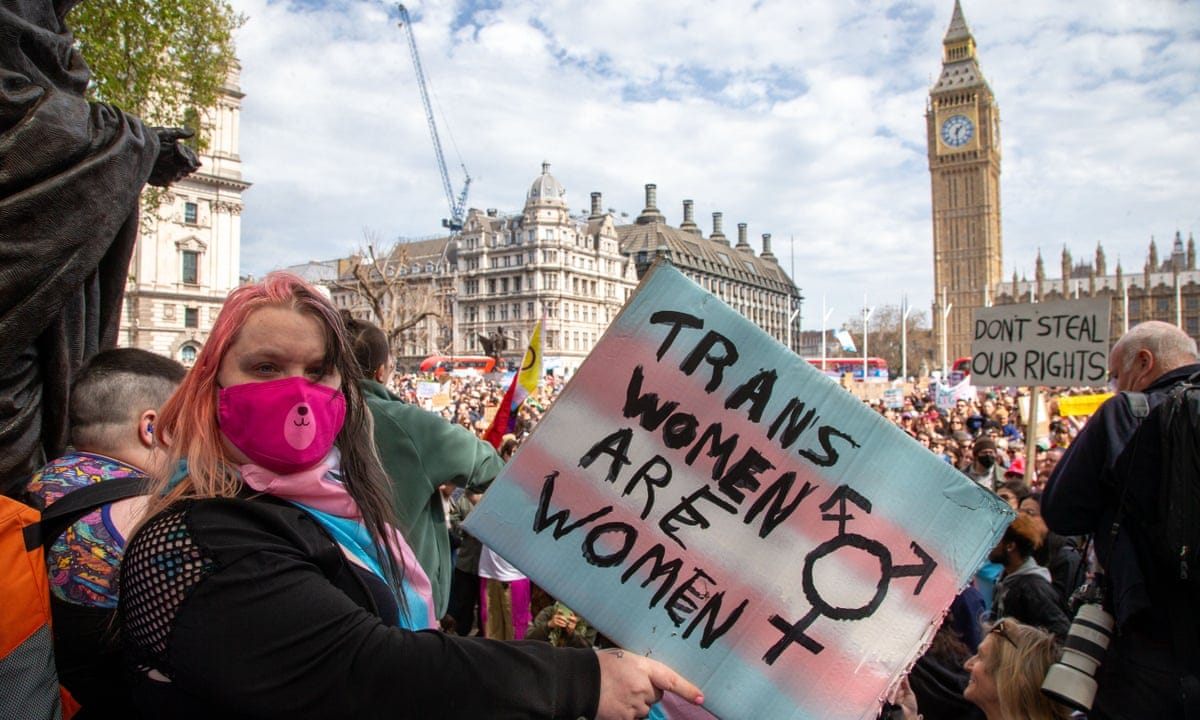
A door stands at the entrance to every women’s refuge in Britain, and for over fifty years it has run on one unspoken principle.
It does not ask who you are.
It does not weigh your character.
It does not assess your intent.
It asks the only question it can verify, and, depending on the answer, it opens or stays shut.
Most men will never stand at that door. Of those who might, almost all mean no harm. The door knows this. The women who built the refuge knew this. And still it does not open for any of them — not the kind ones, not the safe ones, not the ones who only want to help.
That is not an injustice. It is the design. And that logic is what our public argument about sex and gender has seemed to have forgotten.
Single-Sex Spaces Were Built on a Confession
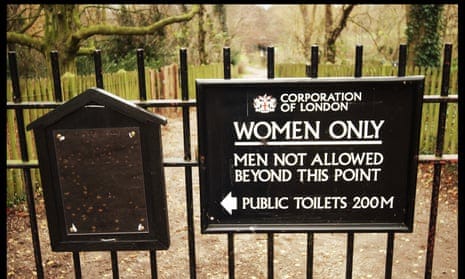
Single-sex spaces were never built on an accusation. They were built on a confession.
Safeguarding — the real kind, refined over decades in refuges, prisons, hospitals and schools — has never worked by vetting individuals. We do not interview men at the shelter door to determine which are dangerous. Not because we believe every man is a predator, but for a more humbling reason.
We cannot tell.
Predators do not announce themselves. They present well. They are charming, plausible, often respected — not incidentally, but as method. Every safeguarding disaster in institutional memory begins the same way: someone believed they could assess a man’s heart, and was wrong.
So safeguarding anchors itself to the body, which it can verify, precisely because it cannot verify the heart. It has to.
Single-sex spaces were never an accusation against any individual man. They were an admission that intent cannot be assessed at the door. The boundary, not the assessment, carries the protection.
Which is why the standard defence of self-identification — trans women are not a threat — answers a question nobody asked. The refuge door never claimed that men, as individuals, are threats. It claimed that no one can spot a threat in advance. The question was never Is this person dangerous?
It was always can this rule still exclude the dangerous person who will, sooner or later, arrive?
That is the question self-identification changes. A lock that opens to a verified fact and a lock that opens to a declared identity are different mechanisms — and they stay different even if every person who has so far walked through the second one meant no harm. After the change, the door cannot close against any male person who says the words. The predator who once stood outside the category now stands inside it, because the redrawn category tests no one and refuses no one.
This says nothing about trans people — their character, their statistics, their sincerity. It is a claim about what a rule can still do. It does not need a single bad actor to be true. It needs only what safeguarding has always assumed: that one will eventually come, and that we will not see him coming.
The Noun That Won the Argument

Nobody won the public argument for this change, because the argument, stated plainly, loses everywhere it is tried. Every single time.
Put it to any audience in its plain form — should a male person undress in a communal changing room used by teenage girls? — and the answer is no. Instantly, universally, across every tribe. That argument has never been won because it has never been made. Ever.
Instead, the classification changed, as a verbal sleight of hand, and then entitlements travelled inside, smuggled into the word.
The philosopher Charles Stevenson called this a persuasive definition: change what a word describes while keeping its emotional freight.1 “Woman” carries centuries of moral weight — sympathy, protectiveness, and every sex-based right that women marched and litigated to win. Change the membership criteria while keeping the word, and everything the word entitles its members to transfers automatically. None of it re-argued. None of it even noticed.
You can watch the mechanism at work in just two sentences.
Should a biological male expose himself in front of underage girls? No — instantly.
Should a trans woman be excluded from the women’s changing room? Surely not.
Same person. Same room. Same act. Opposite verdicts, selected entirely by the noun.
The same principle runs through this whole series I have been making about language and reality:
Classification precedes moral judgement.
We do not assess situations and then label them. We label them, and the label does the assessing for us. The side that wins the noun does not need to win the argument.
The noun is and becomes the argument.
The Freeze: When Truth Becomes Unspeakable
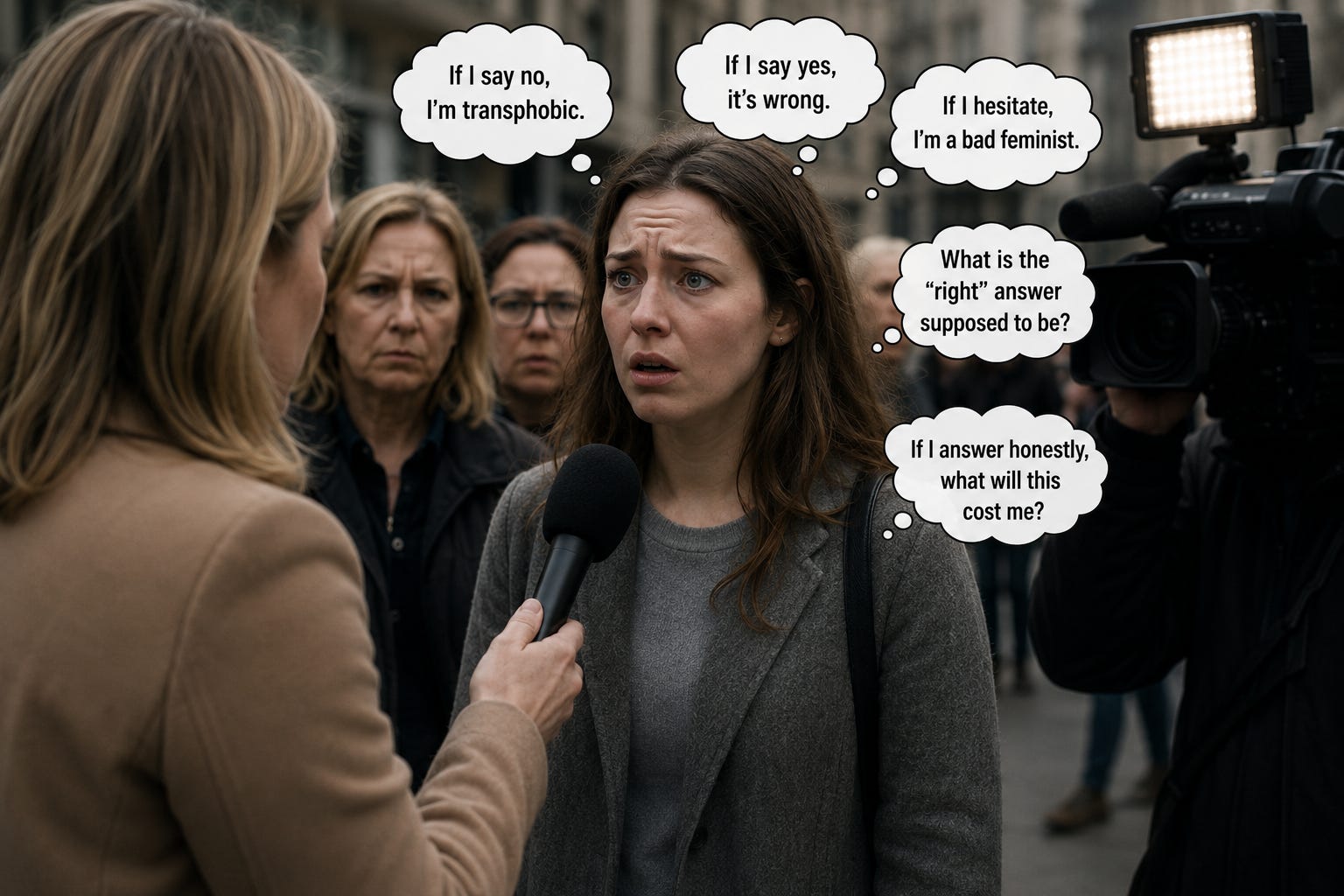
Hence the spectacle: intelligent, morally serious women, asked the plain question on camera, visibly unable to answer it.
It is tempting to call this moral cowardice. Research suggests something more precise, and perhaps more forgivable.
Philip Tetlock’s work on sacred values shows that once a community sacralises a value, its members experience the act of weighing it — any cost–benefit thinking at all — as a moral violation.2 They do not reason badly about the sacred; they refuse to reason about it, and they direct outrage at whoever asks. Where trans inclusion has been sacralised — and in elite professional culture it has — a safeguarding question is not heard as a question. It is heard as desecration. The woman freezing on camera is not failing to compute the risk. She is refusing a mode of thought her community has coded as utterly profane.
Timur Kuran adds the second layer: preference falsification. When stating a private belief costs more than concealing it, people publicly profess what they privately doubt. Each believes she is nearly alone, because everyone around her is doing the same — and that mutual concealment manufactures the very consensus that keeps them all silent. The freeze may not be confusion. It may be a woman calculating, accurately and in real time, what an honest answer would cost her.
Kuran’s model makes one further prediction: these equilibria do not erode over time. Rather, they collapse suddenly when enough people discover they were never alone. Britain in the last few years — the tribunals, the clinical reviews, the Supreme Court — looks less like a nation changing its mind than a preference cascade. The moment the concealment stopped paying.
Steel-manning: The Exception Is Not the Centre

An argument tested only against its weakest opponents (straw-manning) is not an argument. It is a comfort. So here is the strongest opposing case, as its defenders would make it (steel-manning).
Trans people are a small and disproportionately victimised population; a trans woman in male facilities faces real danger. The incidents cited on the gender-critical side are rare relative to the fear around them, and studies from jurisdictions with inclusive policies report no measurable rise. The loaded changing-room question cuts both ways: describing a trans woman in maximally anatomical terms is itself classification doing moral work — exactly the move this series exists to expose. And sex-based rules have hard cases of their own: the fully transitioned trans man, bearded and male-passing, whom a strict sex-based policy places inside the women’s changing room; and the masculine-presenting women who bear the costs of any regime that polices who looks female enough.
These points have real substance. Notice, though, what they touch and what they do not.
Every one of them is about trans people — their rarity, their vulnerability, their sincerity. The boundary argument is not about trans people. The refuge door never needed most men to be dangerous; it needed the ability to exclude the one who was. A boundary that cannot refuse any male who declares he has lost that ability — for everyone, permanently — whether or not any trans person ever misuses it. The people most likely to exploit an unverifiable criterion are, by definition, not the sincere.
As for the hard cases: every rule has them at its edges. The trans man in the women’s changing room is an awkwardness at the margin. A safeguarding door that cannot shut is a failure at the centre. Judge a rule by what it does at its centre, under adversarial pressure — not by which one makes the more comfortable photograph at the edge.
Nor were single-sex spaces ever enforced by inspection! Consensus enforced them — a social agreement so strong that violation was unthinkable, and enforcement almost never needed. Dissolve the category, and you dissolve the consensus. Self-identification does not solve the policing problem.
It creates it.
The Exception Is Not the Centre

Which raises the harder question: why did so much of the church — its progressive wing first, but not only — adopt this framework so quickly, after holding the opposite anthropology for two thousand years?
Because the framework is not secular. It is a religion. And it is one the church should recognise, because most of its furniture was taken from our house.
Émile Durkheim defined religion not by belief in God but by the division of the world into sacred and profane, policed by a moral community.3 Measure the movement by that standard. It has a creed, recited under social pressure — trans women are women — not a conclusion you reach but a confession you make. It has a conversion narrative: the moment of realisation, the old self renounced, the new name taken — baptism, with the certificate reissued. It has blasphemy laws: misgendering as profanation, punishable. It has saints and martyrs, feast days, heretics tried in public and cast out. Excommunication did not disappear from the modern world. It changed its platforms.
It even has an original sin — the wrong kind of birth, the unearned privilege — that can be confessed but never absolved. And that is the tell, the point where the copy betrays itself. This religion has everything Christianity has except grace. There is no atonement in it, no absolution, no road back. The apology is filed as further evidence. Repentance earns nothing, because the record is to be eternal.
Nor is its doctrine new. Beneath the vocabulary sits one of the oldest claims the church ever fought: that the true self is an inner essence, and the body is not you — merely the raw material the real you is trapped in, and may correct. The gnostics taught that flesh was a mistake to be escaped. Orthodoxy answered with the strangest of its claims: the Word became flesh, and the body is not the prison of the self but part of it — created, fallen, and destined for resurrection. A church that has forgotten why it fought that argument will not recognise it when it returns wearing new vocabulary.
Which brings us to progressive Christianity, and painful irony.
Many progressive Christians came out of conservative church cultures that ran exactly this machinery on them. They were handed creeds to affirm whether or not they believed them. They were taught that some questions were not questions but rebellion, that doubt was a deficiency, that the room would become icy cold around anyone who noticed too much. Their wounds and scars are real, and nothing in this essay disputes them.
But having escaped one system of compelled affirmation, they joined another with the mechanics unchanged — the required words, the unaskable questions, the heresy trial by hashtag — believing that because the sacred objects were new, the machine must be too.
But it never was.
The machinery belongs to no theology, conservative or progressive. It belongs to any community that acquires sacred objects and loses the ability to weigh and judge them. The fundamentalism they fled was never a doctrine. It was a tribal method of inclusion and exclusion. And the method has travelled with them.
Their old wound is now offered as the credential — proof that they, of all people, know coercion when they see it — as if having once been burned were evidence they could not be holding the match to set light to others.
This is why the freeze on the sofa when questioned afflicts the progressive Christian hardest of all. She is not choosing between belief and unbelief. She is choosing between tribal identity and congregations.
We are in no position to lecture the culture about dissolved boundaries or borrowed creeds. But what we can do is say why a safeguarding boundary was never the opposite of love — and why grace was never the same thing as affirmation.
The God Who Separates

The Bible’s first creative acts are separations. Light from darkness. Waters above from waters below. Sea from dry land. Before creation is filled, it is divided — and the dividing is called good. In Genesis, a boundary is not a failure of love; it is the architecture of a habitable world. And when un-creation comes, in the flood, it comes as boundaries collapsing — the separated waters rushing back together.
Scripture maintains this logic wherever it addresses protection. The ark has one door. The fold has walls, and the shepherd calls himself its gate. The law’s fiercest protections — for the widow, the orphan, the stranger — are structural, not sentimental: gleaning rights, sabbath limits, cities of refuge. Israel is never told to protect the vulnerable by assessing, case by case, which powerful people seem trustworthy. It is told to build arrangements that hold regardless of anyone’s charm.
And at the centre of the faith stands a person in whom grace and truth arrive together, undiluted by each other. We have let the culture frame these as competitors — as if love means assenting to whatever a person declares about themselves, and truth-telling is what love does when it fails.
The Incarnation says otherwise.
Love that cannot say true things is flattery with good manners. Truth that cannot protect the vulnerable is accuracy in the service of nothing.
So the Christian position is not complicated, however costly. The trans person in your community bears the image of God — fully, non-negotiably — and is owed protection from real cruelty, some of which, to our shame, has come from people quoting Scripture. That is one obligation. The women and girls in your community are owed the boundaries built from a century of hard knowledge about what cannot be known at a door. That is another. Everything this essay has described exists to persuade you that these are one obligation, and that the second must dissolve into the first.
They are not one obligation. Holding both is not hatred. It is what adulthood in a fallen world requires.
The door of the refuge still does not ask who you are. It never could. That was never its failure. It was its wisdom.
That door was not built because women believed the worst of every man. It was built because they acknowledged the limits of what anyone can know about anyone else.
Stevenson first introduced the concept in his 1938 article titled “Persuasive Definitions,” published in the journal Mind. He later expanded on this theory in his seminal 1944 book, Ethics and Language.
Tetlock, P. E. (2003). Thinking the unthinkable: Sacred values and taboo cognitions. Trends in Cognitive Sciences, 7(7), 320–324. This is the most widely referenced paper that introduces the concept clearly.
Durkheim, É. ([1912] 1995). The Elementary Forms of Religious Life. (K. E. Fields, Trans.). Free Press. In the text, Durkheim formally defines religion as: "A religion is a unified system of beliefs and practices relative to sacred things, that is to say, things set apart and forbidden—beliefs and practices which unite into one single moral community called a Church, all those who adhere to them." (Durkheim 1995, p. 44)