

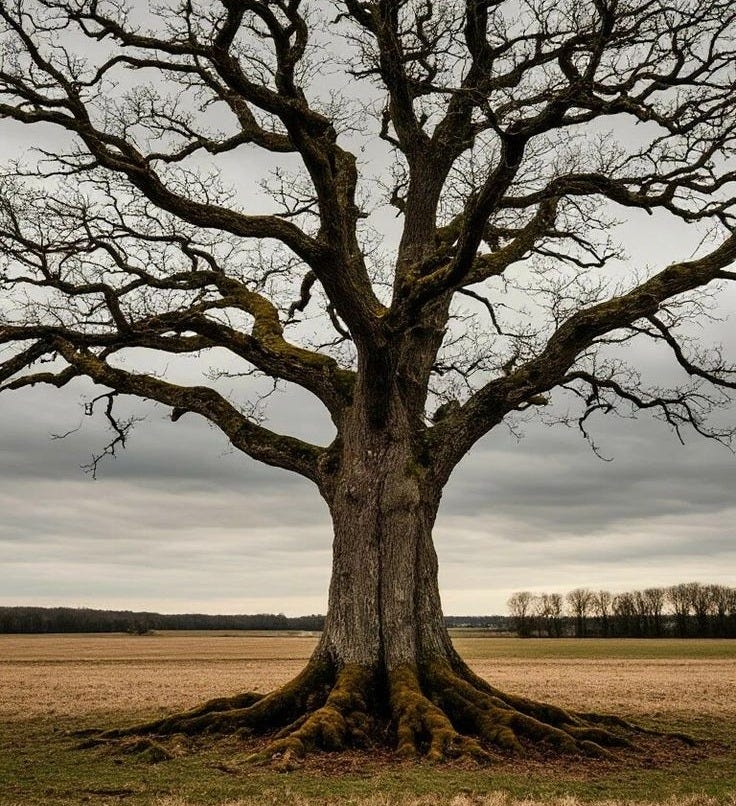
Healthy things grow.
Most of us who lead, in any Christian endeavour, have heard that sentence so often that it no longer sounds like a claim. It sounds like common sense, and sometimes it even sounds like faith. Living things grow, we are told, so a healthy organisation will grow too, with more customers or members, more revenue, more reach and impact. I’ve been party to this claim, and have promulgated it in the pursuit of growth.
And when this growth does not come, we assume something has gone wrong that we can put right, with more competence perhaps, or better planning, more resources and better techniques. Somewhere underneath this strategy is a deep fear that perhaps the thing which has gone wrong is us.
This belief about growth has deep roots. We live in a culture that measures almost everything by productivity. Each year is expected to beat the last: the budget assumes it, the board or the shareholders expect it, and the funders ask for it in every application.
Christians have absorbed more of these assumptions than we tend to notice, whether we lead a congregation or a company. And the belief is in part true. The New Testament expects growth. Luke tells us the Lord added to their number daily (Acts 2:47), and in Jesus’ parable the good seed yields thirty, sixty and a hundred times what was sown (Mark 4:8).1 But living things also wither in drought, lie dormant through winter and are cut back by the gardener.
When Jesus wanted to describe a fruitful life, he reached for a seed going into the ground:
Very truly I tell you, unless a kernel of wheat falls to the ground and dies, it remains only a single seed. But if it dies, it produces many seeds. (John 12:24)
In other words, the kingdom has seasons, and winter is one of them. So, it turns out, does every piece of human work.
Forced to Learn
I suspect the years ahead will teach us this whether we want to learn it or not. Pandemic, war, economic strain and political division have already left many in our workplaces and congregations anxious and tired, and the people leading them are struggling too. Many of the leaders I sit with are tired in a way no holiday or time off can touch. Few of us expect the coming decade to be calmer. A spirituality that only knows how to advance will have little to say to a world in turmoil, and nothing at all to offer the leader who is falling apart in private under the strain.
BTW, I am not arguing that we stop reaching for things in faith, or that ambition in our work is suspect. William Carey’s old charge, to expect great things from God and attempt great things for God, still stands.2 But I wonder if the chaos coming towards us will force us to relearn something we were given at the very start by Jesus and need to recover.
Meeting Christ in his death and resurrection is the birthright of every Christian. Paul says so plainly:
Or don’t you know that all of us who were baptised into Christ Jesus were baptised into his death? We were therefore buried with him through baptism into death in order that, just as Christ was raised from the dead through the glory of the Father, we too may live a new life. (Romans 6:3–4)
In other words, we were baptised into this way of being, and it is meant to go with us into the office and the boardroom as surely as into the church sanctuary. The cross is the shape of the life we were given. If the times ahead strip away our illusion of steady growth, they may hand our birthright back to us. That would be a hard gift, but it would still be a gift. And I have found unexpected help in learning to receive it from J. R. R. Tolkien, a man who watched his world destroyed and still wrote about hope.
The Long Defeat: What Tolkien learned in the trenches
I am no Tolkien scholar, but one line from his letters has stayed with me. In 1956 he wrote to a correspondent that, as a Catholic, he did not expect “’history’ to be anything but a ‘long defeat’”. He added straight away that history also holds glimpses of final victory.3
The phrase came out of his own life. He served on the Somme, in World War I, and by 1918, when he was twenty-six, all but one of his closest friends had been killed.4 It is hard to imagine experiencing that at twenty-six. The world he had grown up in was gone. When he came to write The Lord of the Rings, he wrote about people who expected things to get much worse, and who still did what was right anyway.
Before the march on the Black Gate, Gandalf tells the captains of the West that it is “not our part to master all the tides of the world”.5 Their part is to do what they can in their own years, pulling up the evil in the fields they know, so that those who come after them inherit clean ground.
I find there to be a very real relief in that. It contains a view of time shaped by the cross, and we will need it more as the world grows less and less predictable. A leader whose sense of worth rests on outcomes they cannot control, whether a congregation’s size or a company’s results, will sooner or later break under them. You and I have watched it happen to good people, or have even experienced this ourselves. Gandalf’s charge lifts that burden and hands us, in exchange, something better to carry, and that can transform us. Faithfulness in the field of endeavour in front of us.
Eucatastrophe
If history really is a long defeat, why lead at all? Tolkien’s answer was a word he invented, eucatastrophe. A catastrophe, in the old language of storytelling, is the sudden turn of a story towards disaster. A eucatastrophe (from the Greek eu, good) is the opposite, the sudden turn when everything seems lost and joy breaks in from outside the story. Tolkien described that joy as “Joy beyond the walls of the world, poignant as grief”.6 And he was clear about where the word pointed. In the same essay he calls the Resurrection the eucatastrophe of the story of the Incarnation, and he says that in the Gospel this story has entered real history.
Jesus did not stand outside our long defeat and call encouragement to us. He walked into it. Irenaeus, the second-century bishop of Lyons, called this action of Jesus recapitulation (from the Greek for a summing up, a heading up again), and wrote that in becoming human Christ “commenced afresh the long line of human beings”.7 Christ goes back over the whole human journey; our failures and also our dying are included. And on that same road he turns defeat into new life.
Good Friday is the long defeat in a single afternoon. Holy Saturday is the silence afterwards, the day his friends spent with nothing left but grief, when evil seemed to have won. And then, on Easter morning, something happened that none of them expected and none of them had planned for.
Something broke in. Eucatastrophe.
Easter gives us another way to live and to lead. Our belief in growth wants the harvest now, and despair says there will never be one. But Christ is risen and has not yet returned, so in one sense we live in a long Saturday between his resurrection and his coming again.
We cannot produce growth in our organisations or in our own lives. For those of us used to making things happen, that is hard to hear, and yet it is also good news. Our part is to be drawn into Christ’s dying and rising, again and again trusting that the final Sunday will come because Easter has already become part of us.
Any vision of leadership that leaves no room for Good Friday and Holy Saturday, only Easter Sunday, is not yet Christian. It is a progress story wearing a cross.
The Departure of Boromir: Stopping for what we have lost
Back to The Lord of The Rings. Jake Meador’s essay in Comment, “The Long Defeat of History”, took me back to one scene in The Lord of the Rings that captures everything I have been trying to express.8 The Fellowship of the Ring has just broken apart. Frodo and Sam have gone on towards Mordor alone, orcs have taken Merry and Pippin, and Boromir lies dying, shot through with arrows while defending the two young hobbits. Earlier that same day he had tried to take the Ring from Frodo by force. Now, with Aragorn kneeling beside him, he confesses it. He says what he tried to do, and that he has paid for it. Aragorn does not argue with him or hurry him. He hears the confession and answers it with grace, telling Boromir that he has conquered, and that few have won such a victory. Then Boromir dies.9
Look at how much has been lost in a single afternoon. The company is scattered, and the mission seems to be in ruins. A friend has betrayed them and then died for them. And Aragorn, who has led them since Gandalf fell, blames himself. He believes the company’s ruin is his failure, and that Gandalf’s trust in him was misplaced. Failure, betrayal, grief and self-reproach have arrived all at once, which is how loss usually comes to those who lead.
Aragorn, Legolas and Gimli need to go after their friends, and every minute they wait, the orcs carry them further away. Yet they stop, and they stay. They lay Boromir in a boat with his sword and his broken horn, sing a lament over him, and let the river carry him over the falls of Rauros. It costs them hours they do not have, and they give those hours anyway.
When I compare that scene beside what we do with loss in our own organisations, I notice how rarely we stop. A venture fails, and our post-mortem review often looks only for lessons to move things forward. A business closes, a church folds, a colleague breaks down, betrays us, or dies, a trusted person walks away, and within a week our calendars have covered over the losses with activity. A statement goes out, the strategy is relaunched, and we tell ourselves we are protecting people. Sometimes we are. But just as often we are managing the story, so that the organisation can keep moving and nobody has to stay with the pain of what has happened.
The other habit is erasure. The project nobody mentions any more, the colleague whose name drops out of conversation, the leader who is never spoken of again: we remove what failed as though it had never belonged to us. Managing and erasing look like opposites, but in the end they do the same work. Both spare us grief.
The Fellowship does something harder. They tell the truth about what happened, grieve what they lost, and honour the one who failed and only then do they move on.
Most organisations know how to celebrate a good year and have no way to mourn a bad one, and we miss the clue of how lament fills a large part of the Psalms. We need to learn to stop, to face our losses and grieve them together. And to name the principalities and powers (Paul’s language for forces larger than any one person, working through institutions, markets, crowds and systems) at work whenever the pursuit of forward momentum is allowed to matter more than people.
Boromir’s death is a small eucatastrophe of its own. The worst thing he did is not the last word about him, because his confession is met with grace, and grace is followed by honour. There is hope in that for each of us, and for every failed venture and broken team we carry. None of us can engineer that kind of turn, in an organisation or in our own lives. But we can make room for it when we stop by the river, tell the truth and grieve together, trusting that the One who walked into the long defeat is still bringing life out of it.
So here are two questions to sit with. Whom have we stepped over to keep things growing? And what loss, in our work or in our own lives, have we never stopped to grieve?
Scripture quotations are from the New International Version (Anglicised).
William Carey, sermon on Isaiah 54:2–3, preached in Nottingham, 1792.
Tolkien to Amy Ronald, 15 December 1956, letter 195 in The Letters of J. R. R. Tolkien, ed. Humphrey Carpenter (London: George Allen & Unwin, 1981).
Tolkien, Foreword to the second edition of The Lord of the Rings (1966).
Tolkien, The Return of the King, book 5, chapter 9, “The Last Debate”.
Tolkien, “On Fairy-Stories”, Epilogue, in Tree and Leaf (London: George Allen & Unwin, 1964).
Irenaeus, Against Heresies 3.18.1, trans. Alexander Roberts and William Rambaut, in Ante-Nicene Fathers, vol. 1 (Buffalo: Christian Literature Publishing, 1885).
Jake Meador, “The Long Defeat of History”, Comment, 5 September 2024.
Tolkien, The Two Towers, book 3, chapter 1, “The Departure of Boromir”.
I think about the fallacy of continuous growth when I see our farm fields. After every harvest they have a winter of rest and barrenness and it is necessary for the soil.