

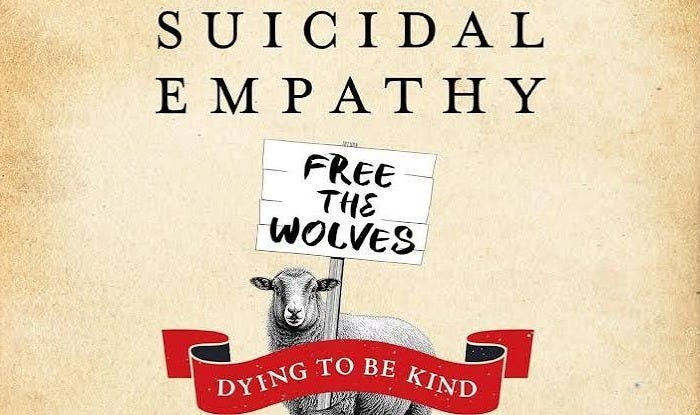
When I was younger, I aspired to empathy. People pointed to it as the mark of a mature person and an emotionally intelligent leader. Whatever else the world needed, it needed more empathy.
But as our world has gone the way it has, I have increasingly wondered whether we have been hijacked by it.
So when Gad Saad began talking about his book Suicidal Empathy, in what felt like a two-year run-up to its publication, I was looking forward to reading it. When it arrived, I found it compelling in its diagnosis and inadequate in its cure.
What has disappointed me most is not the book but the conversation about it. In the press and on the radio, the good and the great keep responding to it as though they have not read it. Saad’s argument is not hard to follow. Yet the discussion collapses into the same assumptions: Saad must be against empathy; empathy is good, so why would anyone want less of it; and the troubles of the world simply prove we need more.
I wonder if something more than careless reading is going on. Perhaps many of those debating suicidal empathy cannot consider that empathy might be the problem, because they already live inside the conditions the book describes. If so, the clearest evidence for Saad’s diagnosis is the conversation about his book.
This is not only a problem for broadcasters. It is a problem for leaders, and for Christian leaders in particular. We talk constantly about things we have never defined: empathy, inclusion, harm, safety. We use these words as if their meaning were obvious and their goodness beyond question. But a word that cannot be questioned cannot be examined.
And a word that cannot be examined can be made to do almost anything, including the most terrible of things.
So here is my proposal. What if Saad is right about the illness and wrong about the cure? And what if the Christian tradition has been carrying the cure all along, in knowing the difference between a feeling and a virtue?
Suicidal Empathy: What Saad actually means
Gad Saad is an evolutionary behavioural scientist, and he is not arguing that empathy is bad. He argues that empathy, like every human capacity, has a limit, and beyond that limit it turns back on the one who feels it.
Suicidal empathy, in Saad’s account, is compassion so unchecked by reason that an individual or a society puts appearing kind above truth, self-preservation and safety.
Four ideas that carry the book
Empathy follows an inverted U: it serves us well up to a point, and beyond that point more of it makes us worse at seeing, judging and acting. It developed among people we knew, locally and reciprocally, but our screens now aim it at millions of strangers and reward us for displaying it. One vivid story outweighs a thousand facts. And, most tellingly for leaders, Saad describes empathy agnosia: the inability to recognise when our empathy is being used against us.
A failure to see
Consider the placards reading “Queers for Palestine”. The empathy is very real. But in Gaza, sex between men is a crime, and Hamas executed one of its own commanders after he was accused of it. The marchers would not last a day under the regime their banners defend. They extend solidarity to people who despise them and who already exploit their compassion. That is not a failure of feeling. It is a failure to see, and it is suicidal empathy in its purest form.
In other words, the problem is not that we feel for others. It is when that feeling, or the need to be seen feeling it, starts making our decisions for us.
Saad’s combative tone loses him readers who most need his argument, me included at times. But his diagnosis names something real.
Misericordia: Why empathy is not a virtue
Let me say something that might sound harsh.
Empathy is not a virtue. It never has been.
A word barely a century old
The psychologist Edward Titchener coined “empathy” in 1909 to translate the German Einfühlung, a term from aesthetics for “feeling into” a painting or a piece of music. For nearly two thousand years of Christian reflection on the moral life, no one listed it among the virtues, because it is not the kind of thing a virtue is.
The tradition named the cardinal virtues of prudence, justice, courage and temperance, and the theological virtues of faith, hope and love. Each is a settled disposition of the whole person to act well. None of them is a feeling.
Feeling or virtue?
Thomas Aquinas asks whether mercy (misericordia) is a virtue, and says it depends on what we mean. If mercy is simply sorrow stirred by another’s distress, it is a passion, a movement of feeling. It becomes a virtue only when reason orders it. He borrows Augustine’s words:
…this movement of the mind obeys the reason, when mercy is vouchsafed in such a way that justice is safeguarded.[1]
That is the distinction the radio conversation never reached.[2]
Empathy is a feeling. Mercy is a virtue.
The feeling may be good, even God-given, but all it can tell us is that someone is in pain. It cannot tell us what is true, what is just, or what would do that person good. Virtue lets us step back far enough to seek the good of the other, which is not always what they want and rarely what would relieve our own discomfort. Empathy without that step back collapses the distance between us. We feel what they feel, we need what they need, and we can no longer see them clearly.
The spotlight
More uncomfortably, much of what passes for empathy serves our need to be seen as good rather than the person in pain. Ten years ago, Paul Bloom’s Against Empathy argued that emotional empathy is biased and innumerate. He likened it to a spotlight that lights up the one in front of us and plunges everyone else into darkness.[3]
The Empathy Shield: A liturgy of display
When empathy is cut loose from truth, it becomes an empathy shield: feeling raised to protect a person, a cause or an identity from examination. Behind the shield, a question is no longer a question. It is an act of harm.
In progressive Christianity, the shield most often bears one word: inclusion. Inclusion began as a Christian instinct, and a beautiful one; the table of Jesus was scandalously wide. But inclusion as an ideology makes the felt experience of harm the final arbiter of truth. Every disagreement becomes an injury, and every critic an aggressor. (I have written more about this in How ‘Inclusive’ Church Excludes.)
The women who disappeared
In the debate over sex and gender, women who want to protect single-sex spaces have been called hateful, bigoted and dangerous, and some have lost jobs and friendships. In April 2025 the UK Supreme Court ruled that “sex” in the Equality Act means biological sex, confirming that their concern was neither fringe nor illegitimate.[4] Yet parts of the progressive Church have been slow to hear them.
Here is Bloom’s spotlight at work. Empathy for trans women has been extended so completely that women have disappeared into the dark. Trans people are made in the image of God and are owed dignity, care and welcome. That is not in question. The question is whether loving them requires us to silence women.
“A dead daughter or a living son?”
That question is put to parents of gender-distressed children, and it is empathy weaponised. A child’s suffering is real, and the threat of suicide silences every other question. Yet the Cass Review found the evidence for medical transition in children remarkably weak, and no good evidence that puberty blockers reduce suicide risk. Many of the young people referred were autistic or struggling with other mental health problems. They were set on a path that permanently alters their bodies, with outcomes no one could show. Now the draft Conversion Practices Bill threatens to treat parents who urge caution as offenders.
Compassion that cannot bear a child’s distress long enough to ask what is true has stopped being love.
It is suicidal empathy with a prescription pad.
A perverted liturgy
These examples behave like a perverted liturgy, a ritual repeated until it forms those who perform it. Empathy is displayed. A victim is named. A villain is found and vilified. The display confers moral standing, and moral standing must then be defended at all costs. This is how virtue signalling slides into cancel culture and “no debate”. It produces a goodness that depends on being seen, with a villain standing beside it.
Mirror, Mirror: Conservatives do it too
It would be easy, and dishonest, to stop there. The empathy shield is not a progressive invention. Conservative and evangelical churches have raised it for decades around a different object: the gifted leader.
From authority…
In older scandals, such as John Smyth’s abuse of boys connected with Christian holiday camps and Jonathan Fletcher’s abuse of men in his circle, the shield was built from deference, class and hierarchy. To question the leader was to question the institution. The Makin Review into Smyth led to the resignation of the Archbishop of Canterbury in 2024.
…to intimacy
Recent scandals feel different. The 2024 independent review into Soul Survivor found that Mike Pilavachi “manipulated and controlled others, bullied and sought to abuse his power” over young people in his care. It describes a leader seen as “anointed”, a stage lit for tens of thousands, and an organisation so successful that “people do not look carefully enough about what the price may be.”
The older abuse ran on authority. The newer abuse runs on intimacy. Social scientists call it a parasocial relationship: the feeling of knowing someone we have only met through a stage or a screen. We feel their warmth, their vulnerability, their humour. So when evidence arrives, it lands not as information but as an attack on a friend, and the mind screens it out.
This is empathy agnosia with a platform and a worship band, and none of us, on any side, has any business pretending otherwise.
Anxious Presence: Why leaders get captured
The anxious system
Edwin Friedman saw it coming decades ago. In A Failure of Nerve he argued that our culture had turned empathy into a tool with which the most anxious members of a system control its leaders. The leader who takes a clear position is told they lack compassion. The leader who wants to be thought compassionate gives way. The whole system slowly reorganises itself around its least mature members.
Friedman’s answer was differentiation: the capacity to stay connected to people without being governed by their anxiety. The undifferentiated leader soaks up every feeling in the room. The differentiated leader can feel it, name it, and still decide.
The affective turn
We now lead in what scholars call the affective turn, a culture in which feeling has become the test of truth. “I feel unsafe” closes a conversation that “I think you are wrong” would once have opened. Decisions are no longer made by conviction or evidence, but by whoever is most upset.
A self that must be defended
Beneath the anxiety lies a question of identity. A self that must create itself needs constant affirmation to survive, so disagreement feels like annihilation. Such a self cannot afford to say the true thing, because the true thing risks the approval that holds it together. All it can do is perform empathy, loudly, and defend the performance. The shield protects a self as much as a cause.
Where Saad’s Cure Goes Wrong
Sound advice
Saad offers what he calls an inoculation protocol, and much of it is sound. Refuse the dopamine hit of moral preening. Think about second-order consequences, not just the immediate emotional hit. Trust the pattern in verifiable data over a single heart-rending anecdote. Find the courage to say what is true, whatever it costs. Any Christian formed in prudence, justice and courage can agree.
Rationed love
But then the cure takes a darker turn. Saad argues that empathy should be extended only to those who share the values of a civil society, and directed according to “fitness payoffs“: favouring those closest to us in blood and civilisation, because they offer the best return for our survival and our genes.
Jesus tells the parable of the Good Samaritan to a man looking for the limits of his obligation, and it is precisely a story of compassion that crosses the lines of kin, tribe and shared values. Saad’s remedy does not heal disordered empathy. It rations it. Feeling is still in charge; it has simply been recruited to the tribe.
When science becomes a worldview
This is what happens when the human person is seen only through the lens of evolutionary biology. My quarrel is not with the science. Christians have long affirmed that God can work through the slow processes of nature. My quarrel is instead with the story smuggled in alongside it: that survival and reproduction are the final truth about what we are and what love is for.
In other words, a good way of studying how living things came to be has been turned into a claim about what we are and why we exist, as though explaining where empathy came from also tells us what it is for. If that is all we are, Saad’s remedy makes perfect sense. Empathy is a resource, and resources should be invested where they pay.
The Christian doctrine of creation tells a different story. We are not organisms maximising returns. We are creatures made in the image of God, made from love and for love, and the measure of that love is not fitness but Christ.
But God demonstrates his own love for us in this: while we were still sinners, Christ died for us. (Romans 5:8)
By the logic of fitness payoffs, the cross is the most maladaptive act in history.
It is love spent on enemies, with no return. Which raises an obvious question. Was Jesus, then, the ultimate case of suicidal empathy?
No. And the reason why is the heart of this article.
Ordo Amoris: A self that does not need defending
Compassion with a backbone
Watch Jesus. He weeps at the tomb of his friend Lazarus. He is moved with compassion for crowds who are like sheep without a shepherd. Yet he lets the rich young ruler walk away sorrowful and does not run after him to soften the terms. And when the crowds in Jerusalem believe in him because of his signs, John tells us something startling:
But Jesus would not entrust himself to them, because he knew all people. (John 2:24)
“Get behind me”
Jesus tells his friends that he must suffer and die, and Peter, out of love, takes him aside to stop it: “Never, Lord! This shall never happen to you!” It may be the most empathetic sentence in the Gospels. Jesus replies:
Get behind me, Satan! You are a stumbling block to me; you do not have in mind the concerns of God, but merely human concerns. (Matthew 16:23)
Jesus is not short of feeling. He is simply not governed by it.
He can hear the love of his closest friend and still refuse it, because his identity does not rest on Peter’s approval. At the Jordan he had already heard the only verdict that mattered: “You are my Son, whom I love.”
A received self
That is the heart of what ails us. A received identity is given by God, not achieved by us, so it does not need defending. And a self that does not need defending is free to love well. It can feel another’s pain without being ruled by it, say the hard, true thing without needing to win, and welcome others without surrendering the truth. It does not need an empathy shield.
The order of love
Augustine called this the ordo amoris, the order of love: loving each thing in its proper place and proportion. We do not produce it by trying harder to feel the right amount. We receive it as we are drawn into the life of Christ, who recapitulated our humanity from the inside, loving perfectly and never once being captured. The Eastern Church calls this theosis, the slow work by which God remakes us in Christ’s likeness as we share his life. The cure for disordered empathy is not less love. It is participation in the One whose love is perfectly ordered.
Putting It Into Practice
For leaders
Notice the movement. When a strong wave of feeling rises for someone, pause before acting and name it.
Empathy is information, not instruction.
Ask where it is leading. The question is not whether a feeling is pleasant but where it is taking us. Towards truth, courage and the good of everyone involved? Or towards relief from conflict and the approval of the crowd?
Hold outcomes with open hands. This is the Ignatian practice of indifference, which does not mean not caring. It means being free enough not to need a particular result, including the result of being liked.
Act against the pull. When fear of disapproval tugs us towards silence, we say the true thing, and we say it kindly.
For communities and organisations
Protect the person who asks the uncomfortable question. Keep pastoral care distinct from the decision about what is true. Let the evidence be heard before feeling closes the case. And refuse the cult of celebrity, including our own.
Well said Jason. Across the pond suicidal empathy is alive and well in this political election year.